
General Information
The following information is the main Rules for Rimfire and Air Rifle Benchrest Competitions developed to suit international shooting. The following Rules can be used for Local, National and Continental Championships by member associations. These rules will be used for all World and European Rimfire and Air Rifle Benchrest Championships from 2013 onwards and regional/ continental matches held under the banner of the WRABF/ ERABSF – as ‘local rules’. Targets used in all competitions will be the Official World and European Rimfire and Air Rifle Benchrest Targets as supplied as a master for printing on A3 sheet (here by referred to as WRABF and ERABSF targets) (See APPENDIX F for details). This consists of 25 scoring targets. English will be the official language, both aurally and in writing, at the shooting ranges during championship.
Affiliation
The World Rimfire and Air Rifle Benchrest Federation (WRABF) and European Rimfire and Air Rifle Benchrest Shooting Federation (ERABSF) cover the majority of Rimfire and Air Rifle competitions at 25 meters and 50 meters. Affiliation to the WRABF and ERABSF brings national Rimfire and Air Rifle benchrest shooting organizations under the same main rules of shooting set out below, with specific adaptation to suit other forms of rimfire and Air Rifle benchrest. These adaptations may cover distance, classes, and targets all to suit other world and continental rimfire benchrest shooting and club facilities.
Eligibility of Venue
The shooting venue where the championship is to be held must be approved and insured, hold a current license for the use of the firearms being used and abide by the Firearms Licensing Regulations of that country. It will be the responsibility of the host association / organizers to ensure that the range and facilities are of a high standard suitable for the conduct of the Championship. The Host will also need to organize volunteers to assist in running the event.
Acceptance of terms and conditions
By entering the world championship, individuals, teams, and national associations/ federations are officially accepting the rules stated within this document. This relates to all aspects of the championship including equipment and behavior. The disqualification rules outlined within this document are very important to consider and it is the responsibility of all individuals, teams, and national associations/ federations to make themselves aware of these facts. Where rules are broken or issues raised, a normal protest can take place during the match-by-match officials and/ or the protest committee. If rules have been explicitly broken and this is discovered after the championship, then an Emergency General Meeting of international delegates will take place to consider the facts/ evidence and come to a decision. If upheld, individuals and/ or teams can be disqualified or have scores removed in the same way the protest system works. (This would be an exceptional circumstance)
SECTION A Administration.
A.1 Authority:
The World Championships, World Cup, European and regional/ continental Rimfire and Air Rifle Benchrest Shooting Championships are conducted on the authority of the World Rimfire and Air Rifle Benchrest Federation (known as the WRABF) and the European Rimfire and Air Rifle Benchrest Shooting Federation (known as the ERABSF). This has been approved by the Delegates Committee.
A.2 Recognition of Member Countries:
There is no restriction on the number of countries that may join the World/ European Rimfire and Air Rifle Benchrest Federation, subject to them meeting the admission criteria established within these rules, fulfilling financial obligations, and meeting the appropriate standards of behavior and sportsmanship. A country may be expelled, and membership cancelled by the delegates attending a meeting duly called and constituted by these rules. Such expulsion will be by a 2/3rd majority ballot of those country delegates present.
A.3 Recognized Body
It is for each member country, to establish the body within its jurisdiction that will be recognized for participation at any rimfire championship conducted under the auspices of the World/ European Rimfire and Air Rifle Benchrest Federation. However, only one body per country can be represented at the World/ European Rimfire and Air Rifle Benchrest Federation Delegates Meetings per A4. The body representing each country must be a member of the World/ European Rimfire and Air Rifle Benchrest Federation. Only one member federation/ association representing rimfire and/ or air rifle benchrest from each country is allowed to be a member of the World/ European Rimfire and Air Rifle Benchrest Federation.
A.4 Types of Membership
A4.1 Full Membership
Each country accepted for membership is entitled to appoint a representative to care for their interests and attend any meetings of the WRABF/ ERABSF Delegates Committee.
A4.2 Other Membership
Each country accepted for membership under conditions set by the executive committee, as per the constitution, is entitled to appoint a representative to care for their interests and attend any meetings of the WRABF/ ERABSF Delegates Committee.
A.5 Multiple Representations.
Where more than one organization pursues the interests of Rimfire/Air Rifle Benchrest Shooting within a particular country, it is for that country to determine representation. However, the World/ European Rimfire and Air Rifle Benchrest Federation Advisory Committee will only recognize one such body in any one country. Where an Association / Federation accept such responsibility, it is required to ensure all competitors from that country who wish to represent their country, are provided with the opportunity to qualify for such teams.
A.6 International Affiliation.
It is expected that any country / association recognition, should be capable of/or recognized by the controlling body of sports shooting in that country, to ensure full international status can be conveyed on the country’s representatives.
A.7 Advisory Committee Meetings.
An Advisory Committee Meeting will be held at each World/ European Rimfire and Air Rifle Championship to discuss matters relative to the conduct of the Rimfire and Air Rifle Championship. The Advisory Committee meeting will be conducted by the Chairman/ President of the World/ European Rimfire and Air Rifle Benchrest Federation or his nominee if unavailable to attend. Representation will be by a Delegate from each approved country who may be accompanied by an official observer. Each delegate present at the meeting will hold one vote. The Chairman/ President may hold his countries vote or a casting vote, but not both.
A.8 Membership Fees.
Member countries will be responsible for the payment of any membership fees or levies determined from time to time by the World/ European Rimfire and Air Rifle Benchrest Federation Delegates Meeting. Failure to meet deadlines set for the payment of such fees will result in the non-acceptance of shooters from that country in any events conducted by the World Rimfire and Air Rifle Benchrest Federation. Annual WRABF membership costs for each country are set at $50 US. This is to be paid to the treasurer at the beginning of each year starting in 2012. Membership fees maybe adjusted from to time to time by the WRABF executive committee.
Annual ERABSF membership costs for each country are set at €40. This is to be paid to the treasurer at the beginning of each year starting in 2013. Membership fees maybe adjusted from to time to time by the ERABSF executive committee.
A.9 Conduct of Events.
A WRABF World Championship shall be conducted every four years. A WRABF World Cup will also be held every four years (at the same time and venue as the European Championship), (two years after and two years before) each World Championship. All events at such Championships will be conducted in accordance with these Rules. Should the host country traditionally conduct events in metric equivalences, same will be allowed, however all events for that Championship will be conducted in metric values.
A.10 Changes to Rules to be used at WRABF/ European Rimfire Championship.
Should changes be required to these rules, these should be advised to the Executive Committee members at least one year prior to competition, and confirmation of such changes approved by the next Executive meeting. Should no such changes be advised, then the competition will proceed based on the published information. A temporary change for a specific Championship can be approved by the President or nominee, in consultation with the Championship Organising Committee, subject to majority competing countries approving in writing that such change has their agreement.
A.11 New Competition Events.
These Rules contain all events that are currently approved by the Delegates Committee for competitions. Should a member wish to provide an alternative competition or include an additional event on the programme, such detail must be submitted to the Executive Committee two years prior to competition. Such application must be accompanied by the Rules of Competition under which the event will be conducted and confirmation that all administrative matters (medals, teams etc) as provided in these Rules will prevail.
A.12 Competitor Accreditation.
Only competitors nominated by their affiliated country/association who have met their financial obligations and who hold that countries citizenship or residency qualification will be accepted. In the event of doubt, the shooters primary place of residency will determine eligibility, through verification of the competitor’s passport. Where a competitor has previously competed for another country, that shooter can compete for a new country if the shooter holds citizenship of the new country.
A.13 Territory or Protectorate.
The recognized National Shooting Association of such territories or protectorates may seek Affiliate membership of WRABF/ ERABSF.
A.14 Minimum Number of Individual Competitors.
For a World/ European Rimfire and Air rifle Championship to be conducted there must be thirty competitors representing a minimum of five countries. (Levels of junior representation will be set by the WRABF/ ERABSF executive committees. There is no limit on the number of Junior competitors with the expectation that a minimum of one place will be allocated to each country for a junior representative). The minimum number of competitors from each country shall be one competitor.
A.15 Maximum Number of Individual Competitors.
Each participating country may enter an open number of competitors in each event of the championship – depending on how many places their country has been allocated by the Match Director/ Organising Committee. This is dependent of the number of countries attending the championship. This can include juniors (who must be up to 18 years of age in the current year) who will be allocated places by the Executive Committee working with the Match Director/ Organising Committee. Juniors will take part in the main championship and will be eligible for both junior and senior places. Where extra or spare places that cannot be shared equally, spare places will be allocated to countries based on an average score selection system to ensure the best shooters attend the championship.
A.16 Team Competition - Minimum Number of Teams.
There must be two participating countries for team awards to take place. However, there must be three teams available from those two countries so 1st, 2nd and 3rd place can be competed for. Countries can also enter Junior teams which must form part of the five teams for the country. There will be no separate Junior teams as part of the competition. Juniors will enter as individuals who will compete in both the Junior and Open class. Countries can enter a junior team for the open class only.
A.17 Size of Teams.
Each country can enter up to five teams of three shooters in each event/ class depending on a country’s place allocation (of which team members can be juniors). The team of shooters names to be registered as stated above under Registration. Up to five teams from each country can enter each class or match – depending on what places countries have been allocated. Scoring will be an aggregate of scores.
achieved as individuals, amassed as the registered team of three, max score 2250 with 75 X's. Changes to teams must be made 8.30 am on the day of the match. Countries must select their teams based on merit.
A.18 Reserves.
It is recognized that countries may wish to have reserves available in the event of difficulties within a team where there is a team award. Reserves will be able to shoot during official and unofficial practice days but will not be permitted to participate as part of a team unless they replace a team member officially. (All reserves can shoot as individuals within a match/ championship depending on that they are within the limits of a countries place allocation). Reserves will not be included in the awards ceremony for team events unless they have replaced a team member and shot for the team. If replaced, the original team member replaced can no longer be included in the awards ceremony for that team.
A.19 Use of Reserves.
Changes to teams must be made before matches commence by 8.30 am on the morning of the scheduled start of the first match.
A.20 Teams Competition participants.
For a Team score to be recorded, all team members must complete the specific class of the competition. Teams & names must be listed before the events; these should also be clearly posted at the event, with any changes notified in writing before the match begins.
A.21 World/ European Championship Records.
World/ European Rimfire and Air Rifle Championship records are established at Championship events and are recorded on the World/ European Federation websites respectively. Where records are established a medal/certificate must be given to the record holder to acknowledge the achievement.
A.21.a Un-confirmed Records.
The results as published at each championship can be used to indicate that an unconfirmed new World Rimfire and Air Rifle Championship Record have been established.
A.21.b Confirmed Record.
The Executive Committee shall appoint a Technical Group for the final scoring/ confirmation of proposed new records. Such group can meet in person or by correspondence. All targets that constitute the record shall be made available to the Technical Group by the shooters Team Leader via the World/
European Rimfire and Air Rifle Benchrest Federation President or nominee, accompanied by appropriate application form. It will be for the President to announce any new records so obtained. There shall be no appeal rights available because of the Technical Group or the President’s deliberations in this matter. Records established will be recorded on the WRABF/ ERABSF website for future reference and scoring. New records will be announced via the President via the official WRABF/ ERABSF website.
A.21.c Recording of Records.
Score Records: Recorded as shot. (In Metric)
SECTION B Rules of Competition
B.1 DEFINITIONS
B.2 Championship.
The Championship shall be defined as the conduct of the total tournament.
B.3 Event.
The Event will be those events separately listed in Section D.
B.4. Aggregate.
An Aggregate will be the total score of a day’s matches, or all matches in one class, the aggregate being the final score. 25 diagrams shot at 25 meters or 50 meters with a time limit for matches of maximum 20 minutes outdoor. Each class will consist of three targets to be shot in the same day with bench rotation enforce. A competitor can compete only once in each Class at any Championship. Separate aggregate for air rifle & rimfire events will be recorded.
B.5 Match.
A Match will be a single event (one target) in a Championship.
B.6 Rifle Specifications.
All rifles used in WRABF-sanctioned competitions must be manually and mechanically operated.
Air Rifle (LR and HR) - Rifles Chambered for .177, .20 or .22 and of power / velocity as stated in the Class designation section. Magazines may be used. The use of electronic equipment in all forms is strictly prohibited on and in all rifle classes, except for electronic timers. However, these must be mute so there will be no sound - sportsmanship rules apply.
Rimfire. (a) International Sporter. Is any Sporter having only manually and mechanically operated firing mechanism, max weight not more than 81/2 pounds (3.855kg+28gram allowance = 3.883kg) inclusive of scope. Additional barrel weights, harmonic tuners or bullet stabilisers, barrel attachments (vibration devices) are NOT permitted. Any scope may be used with max magnification of 12X, however where variable power scopes are used, they will have to be taped in position with anti-tamper material to a magnification of no more than 12X, by the referee, for the duration of the match. The barrel/ action can be bedded and have the trigger reworked (or replaced). The barrel profile must be a fixed piece of metal, however formed, with no moveable attachments except for the action nut to secure the barrel to the action. (Original front sights may be left in place but not added to or changed in any way) Stock or stocks that meet ‘Stock Clarification’ rules may be used (see APPENDIX F). No electronic or mechanically assisted triggers allowed. Maximum stock width: 57.15 mm + 1 mm tolerance = 58.15 mm. Prohibited: Barrel weights, harmonic tuners, stabilizers, vibration devices. Any electronic or assisted trigger mechanism, whether internal or external
(b) Light Rifle .22 Rimfire Rifle. Permitted calibers: .22 Short, .22 Long, or .22 Long Rifle (LR) using lead projectiles only. RF LR is any rifle having only manually and mechanically operated firing mechanism, weighing not more than 10 1/2 pounds (4.762 kg+28gram allowance= 4.79kg) inclusive of sight. Any modification may be made to the rifle and any scope may be used. Factory stock or stocks that meet ‘Stock Clarification’ rules may be used (see APPENDIX F). Barrel weights, harmonic tuners or bullet stabilisers are permitted but will be included in the overall weight of gun. No external electronic or mechanically assisted triggers are allowed. Stock tape is permitted. Maximum stock width: 76.2 mm + 1 mm tolerance = 77.2 mm.
Prohibited
Electronic triggers are strictly prohibited:
o This includes all internally or externally powered, factory-installed, or aftermarket electronic systems. Only purely mechanical, manually operated trigger mechanisms are allowed. o
(c) Heavy Rifle .22 Rimfire Rifle. Permitted calibers: .22 Short, .22 Long, or .22 Long Rifle (LR) using lead projectiles only RF HR is any rifle having only manually and mechanically operated firing mechanism and a weight restriction of 15 lbs. is set (6.803kg+28gram allowance = 6.831Kg) (including attachments – scopes, muzzle devices, etc.). Any modification may be made to the rifle and any scope magnification may be used. Factory stock or stocks that meet ‘Stock Clarification’ rules may be used (see APPENDIX F). Barrel weights, harmonic, or bullet stabilizers tuners are permitted. No external electronic or mechanically assisted triggers are allowed. Stock tape is permitted. Maximum stock width: 76.2 mm + 1 mm tolerance = 77.2 mm Electronic triggers are strictly prohibited, as defined in RF LR
Clarification: In all Rimfire Classes (IS, LR, HR), the trigger mechanism must operate purely through mechanical means with no electrical assistance. This includes but is not limited to solenoid-based triggers, electric contacts, piezoelectric elements, battery-operated or capacitor-based actuation systems. Any rifle found to incorporate such a system, regardless of whether it is embedded within the action or externally mounted, shall be disqualified
Air Rifle. (a) Light Rifle Air Rifle Class. AR LR is any rifle having only manually and mechanically operated firing mechanism, weighing not more than 10 1/2 pounds (4.762 kg+28gr allowance = 4.79Kg) inclusive of sight. Factory stock or stocks that meet ‘Stock Clarification’ rules may be used (see APPENDIX F). The action can be either spring or pneumatic; air regulators, barrel weights, harmonic tuners or bullet stabilisers are permitted but will be included in the overall weight of gun. Air regulators can be used if it is integral within the air rifle.
Any magnification scope may be used. The barrel/ action can be bedded and have the trigger reworked (or replaced). Power to be restricted to 16.27 Joules or 12ft lbs. maximum. Build in electronic triggers are allowed however, mechanically, or electronically external assisted triggers are not allowed. Electronic triggers must be part and build into the rifle and no external assisted triggers are allowed. Full electronic rifles are allowed with the exception of external electronically external assisted triggers. Permitted calibers: .177, .20, .22(.2185 inch) Projectiles: Lead pellets or slugs only. Barrel weights, tuners, and internal regulators permitted Stock tape is permitted. Magazines are allowed.
(b) Heavy RIfle Air Rifle. AR HR is any rifle having only manually and mechanically operated firing mechanism, a weight restriction of 15lbs is set (6.803kg+28gram allowance = 6.831kg) (including attachments – scopes, muzzle devices, etc.). Factory stock or stocks that meet ‘Stock Clarification’ rules may be used (see APPENDIX F). Any manual modification may be made to the rifle and any magnification scope may be used. Air regulators can be used if it is integral within the air rifle. Muzzle brakes, muzzle flips, barrel weights or Harmonic Tuners are permitted. There is no restriction on cylinder size or capacity as long as 27.12 Joules or 20ft lbs. maximum power is retained and it is integral within the rifle. (Separate Air Cylinders are not allowed, the cylinder must be part of the rifle and the overall weight). Electronic triggers are allowed however, mechanically, or electronically external assisted triggers are not allowed. Electronic triggers must be part and build into the rifle and no external assisted triggers are allowed. Full electronic rifles are allowed with the exception of external electronically external assisted triggers. Permitted calibers: .177, .20, .22 (.2185) Projectiles: Lead pellets or slugs only. Barrel weights, tuners, and internal regulators permitted Stock tape is permitted. Magazines are allowed.
(c) Unlimited air Rifle Class – 50m. The purpose of this class is to have an open class where weight, energy, speed, and stock rules do not apply. It is any rifle having a manually, mechanically, or electronically operated firing mechanism. Any air rifle caliber up to .2185 inch can be used. Both pellets and slugs can be used. Slug and pellet diameter will be used to determine the size. Build in electronic triggers are allowed and no external electronic triggers are allowed.
The rifle can be shot from a front and back rest, bipod, or X-bag. Magazines are allowed. Silencers/ suppressors are allowed. Calibers up to .2185 inch permitted Chronographs are allowed on the benches There is no restriction on air rifle air cylinder size or capacity that is fitted to the rifle. Tethering is allowed, permitted it can be done safely using a buddy bottle of max 3l (liters). Tethering is the permanent connection of air supply such as buddy bottle to the air cylinder of an Air Rifle. A fixed connection is made between the air cylinder of the rifle to the external air supply reservoir.
Note on Unlimited. The rules are on a trial basis and will be evaluated during the 2023 World Championships and if any rule appears to be unsafe the WRABF executive committee can then decide to amend the rules. (Buddy bottle only – max 3l). During Championships only external Buddy bottles are allowed to be used. No scuba cylinders are allowed. Buddy bottles are small air reservoirs that are compact and traditionally 3l in size. The standard WRABF RimFire (50m) target is used for 50m distance. Scoring must be done with an electronic scoring program for the 50m distance. The measurement to determine if the maximum caliber is adhered to, the slugs or pellets used must be measured using a caliper or similar measuring tool. The match official may after the completion of a relay do random checks to ensure that the required caliber is adhere to. A tolerance of 0.22% (0.0005 inch) will be allowed for possible calibration error. This equates to 0.2185. Should a competitor exceed the measurement it will lead to immediate disqualification for the entire match. The match official’s decision is final; however, the competitor still have the opportunity to lodge a protest. Clarification: electronic triggers must be integrated into the rifle’s internal design. Any system requiring external components (battery packs, cables, controllers) or mounted externally on the rifle or rest will be disqualified
Note Electronic scoring for all classes is compulsorily only at WRABF and ERABSF World Championships and World Cup events. See section “L” for electronic scoring procedures.
B.7 Ammunition.
Rimfire Ammunition must be a lead projectile in .22 Target Rimfire short, long, or long rifle calibers.
Air Rifle ammunition must be a lead pellet or lead slug in caliber .177 .20 or .22 Competitors using hand loaded RimFire ammunition and /or ammunition produced with jacketed bullet, or ammunition not available from regular outlets will be disqualified.
B.8 Rests.
View original PDF tables / diagrams (pages 14)
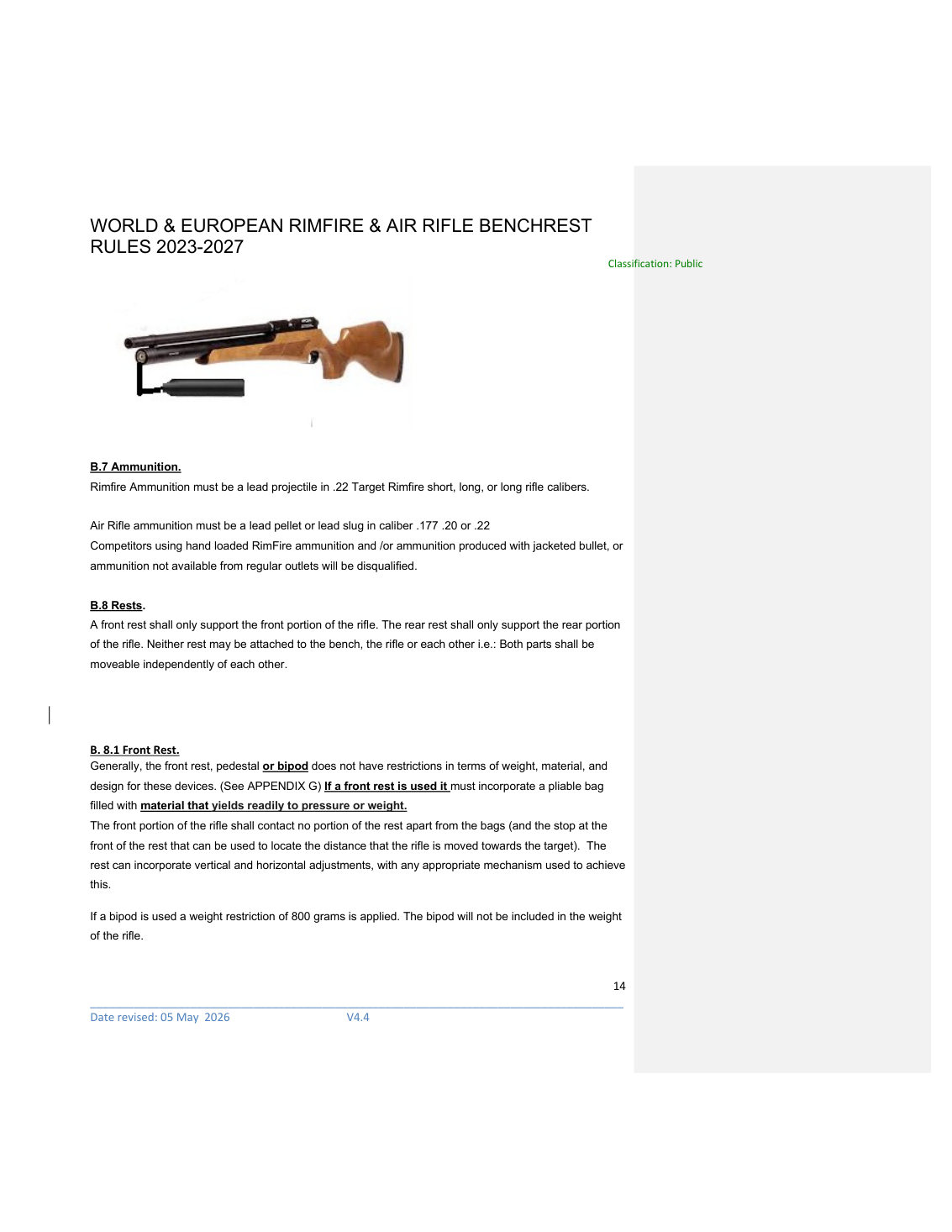
A front rest shall only support the front portion of the rifle. The rear rest shall only support the rear portion of the rifle. Neither rest may be attached to the bench, the rifle or each other i.e.: Both parts shall be moveable independently of each other.
B. 8.1 Front Rest. Generally, the front rest, pedestal or bipod does not have restrictions in terms of weight, material, and design for these devices. (See APPENDIX G) If a front rest is used it must incorporate a pliable bag filled with material that yields readily to pressure or weight. The front portion of the rifle shall contact no portion of the rest apart from the bags (and the stop at the front of the rest that can be used to locate the distance that the rifle is moved towards the target). The rest can incorporate vertical and horizontal adjustments, with any appropriate mechanism used to achieve this.
If a bipod is used a weight restriction of 800 grams is applied. The bipod will not be included in the weight of the rifle.
Whilst bipods can pan and tilt, mechanical bipods that allow movement in the same fashion as a front rest, a mechanism providing vertical and horizontal adjustments, will be deemed a front rest and would be weighed with the rifle.
B.8.2 Rear Rest.
Can be a bag, series of bags or structure that can be fixed in height, that supports a pliable a bag.
Rear rest and or vertical spacers shall not contain any protrusions which can be inserted into the bench top. The rear rest shall not be contained in any way. The rear rest may not contain horizontal adjustment capabilities, only vertical adjustments mechanisms will be allowed, according to rules below. The rear rest must not be mechanically connected to the bench, the rifle, or the front rest. Rear rests must not restrict the natural recoil movement of the rifle. The rifle must be able to slide or lift freely from the rear rest without resistance.
Rear Rest – Prohibited Features The following are expressly prohibited: Any mechanism providing horizontal (lateral) tracking or alignment. Any rigid structures or V-guides that cradle or track the rifle laterally. Any spring-loaded, damped, or return-to-battery systems. Rear rest bases with pins, spikes, or protrusions that insert into the bench. Any combined front-rear “sled” system with integrated tracking
8.2.1 If a front rest or pedestal is used the rear rest can incorporate vertical spacers such as ‘donuts’ or fixed structure. Anti-slip surfaces on the rest may be utilized.
8.2.2 If a bipod is used the rear rest can incorporate vertical spacers such as donuts, if it does not have vertical mechanical adjustments already, to aid acquiring target. Anti-slip surfaces on the rest may be utilized. If a bipod is used as a front rest, the rear rest may incorporate fixed-height vertical spacers to help align the rifle with the target. No lateral adjustment, spring-damping, or mechanical centering components may be present. Anti-slip materials (e.g., rubber mats) under the rear rest are allowed but must not interfere with recoil.
B.9 Sandbag.
Bags must be made of leather and/or cloth (i.e., nylon, polyester) which are filled with material that yields readily to pressure or weight such as a finger press test. Anti-slip surfaces on the bags may be utilized. Talc or non-slip compounds, materials or tapes can be used to aid tracking of the rifle.
B.10 Restraint of Rifles to reduce or manage recoil.
View original PDF tables / diagrams (pages 16, 17, 18)
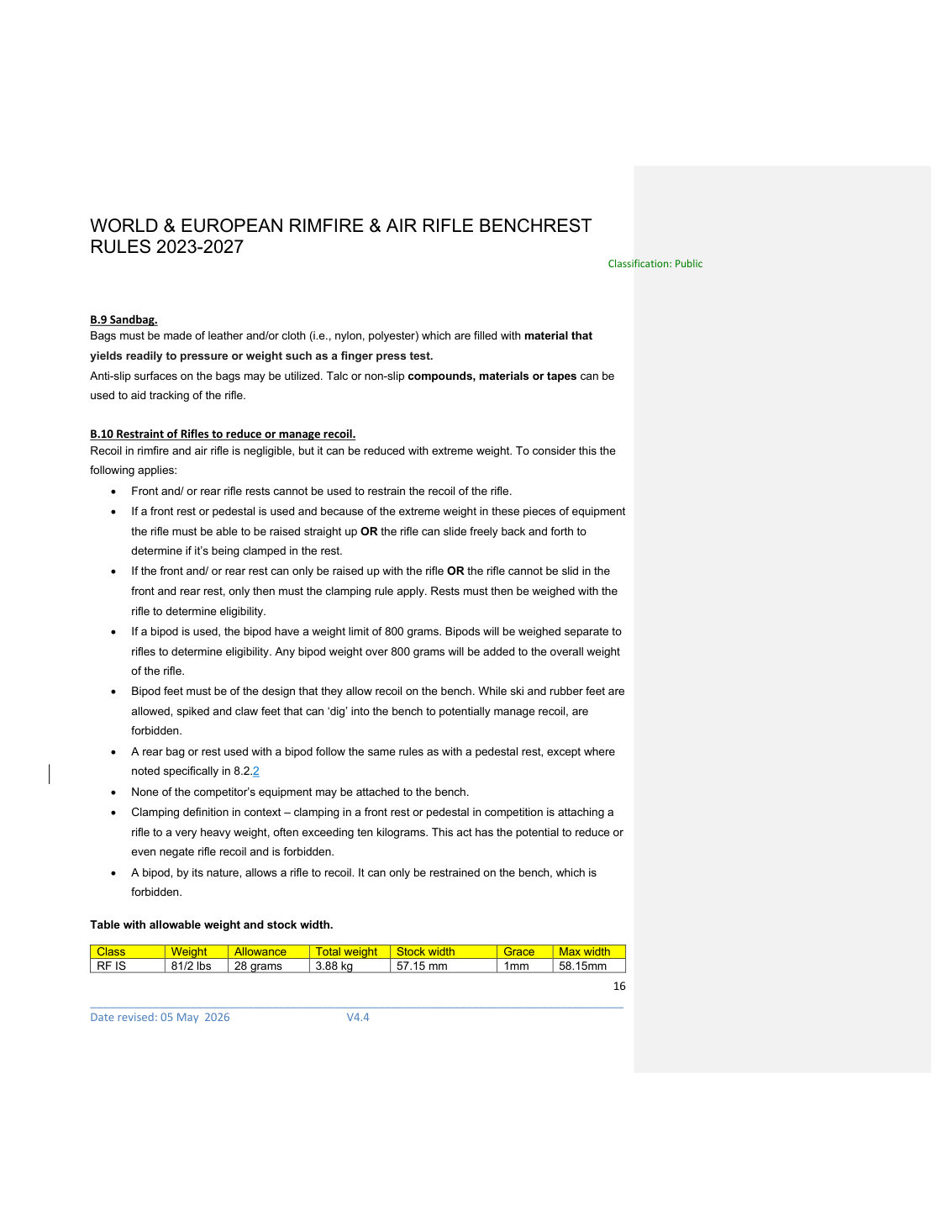
Recoil in rimfire and air rifle is negligible, but it can be reduced with extreme weight. To consider this the following applies: • Front and/ or rear rifle rests cannot be used to restrain the recoil of the rifle. • If a front rest or pedestal is used and because of the extreme weight in these pieces of equipment the rifle must be able to be raised straight up OR the rifle can slide freely back and forth to determine if it’s being clamped in the rest. • If the front and/ or rear rest can only be raised up with the rifle OR the rifle cannot be slid in the front and rear rest, only then must the clamping rule apply. Rests must then be weighed with the rifle to determine eligibility. • If a bipod is used, the bipod have a weight limit of 800 grams. Bipods will be weighed separate to rifles to determine eligibility. Any bipod weight over 800 grams will be added to the overall weight of the rifle. • Bipod feet must be of the design that they allow recoil on the bench. While ski and rubber feet are allowed, spiked and claw feet that can ‘dig’ into the bench to potentially manage recoil, are forbidden. • A rear bag or rest used with a bipod follow the same rules as with a pedestal rest, except where noted specifically in 8.2.2 • None of the competitor’s equipment may be attached to the bench. • Clamping definition in context – clamping in a front rest or pedestal in competition is attaching a rifle to a very heavy weight, often exceeding ten kilograms. This act has the potential to reduce or even negate rifle recoil and is forbidden. • A bipod, by its nature, allows a rifle to recoil. It can only be restrained on the bench, which is forbidden.
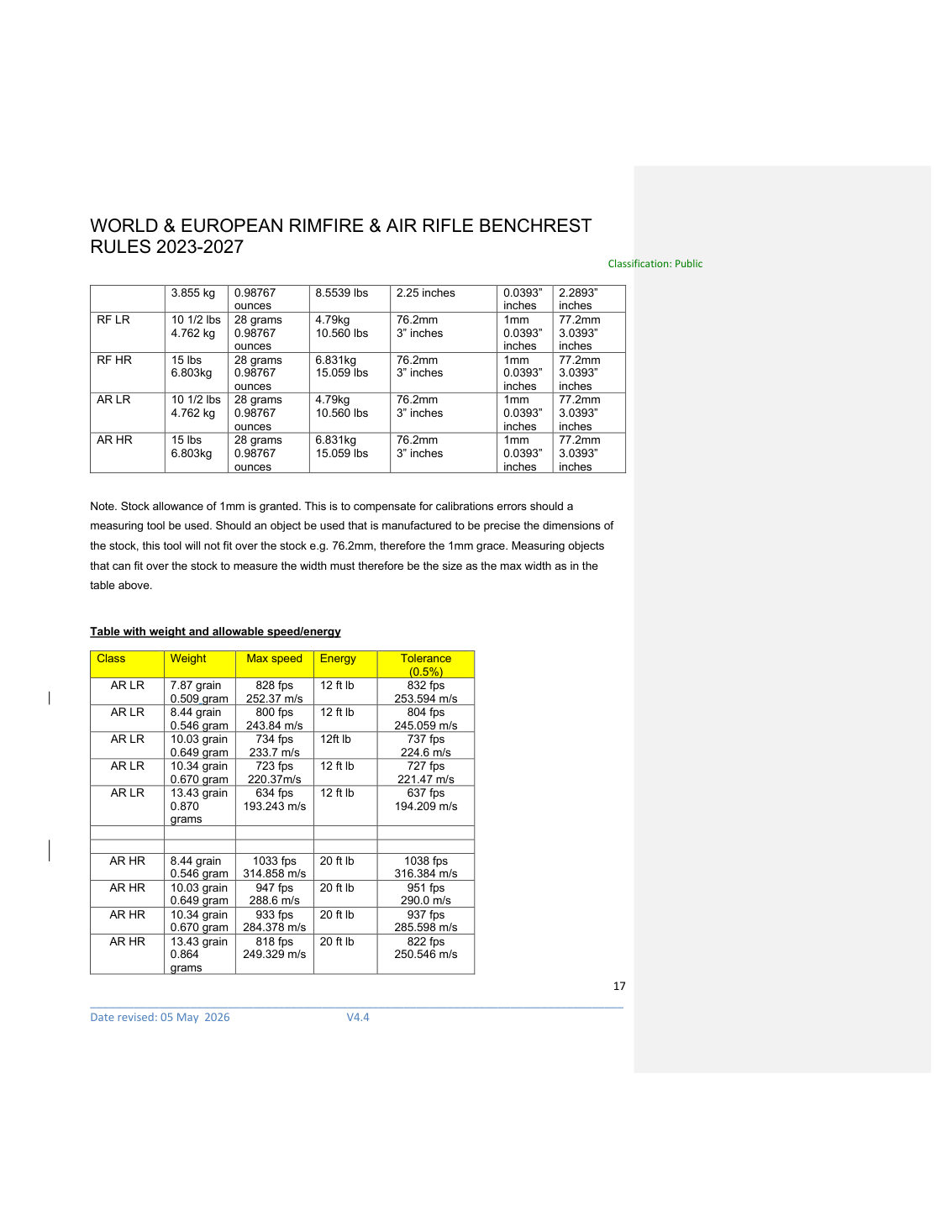
Note. Stock allowance of 1mm is granted. This is to compensate for calibrations errors should a measuring tool be used. Should an object be used that is manufactured to be precise the dimensions of the stock, this tool will not fit over the stock e.g. 76.2mm, therefore the 1mm grace. Measuring objects that can fit over the stock to measure the width must therefore be the size as the max width as in the table above.
B.11 Guiding mean.
Any device, addition, contour, or dimension on a rifle, designed to co-act with any equipment to guide its return to the firing position, without the necessity to re-aim the rifle optically for each shot shall be deemed illegal.
B.12 Firing Line.
The firing line shall preferably be coincident with the forward edge of the bench. If not, the line must be clearly marked on the bench.
B.13 Bench.
A bench shall be a rigidly constructed table at which a shooter may sit. The shooter should be able to adjust personal height via the seat or stool which should be adjustable. Benches should be constructed to allow firing by either right or left-handed competitors. During a match competitors or team officials cannot occupy any bench if they are not competing. There will be a designated line that non shooting competitors or spectators shall not cross.
B.14 Position on the bench.
The rifle shall be so placed that the muzzle extends towards the firing line at the front of the bench and the entire receiver of the rifle is behind the firing line.
B.15 Unused Benches.
No competitor or Team Official shall occupy any bench in any match in which they personally are not competing.
B.16 Bench Height.
1. The target height should be higher than the bench height and will be considered when an application is made for a World/ European Championship venue. 2. In cases where this is not possible due to range design or contours an application for a deviation must be made to the governing body at least one year in advance of the competition date. This application must be supported by exact measurements of bench height and target height from the same horizontal line. Approval will not be unreasonably withheld.
SECTION C Conduct of Championships
C.1 Targets.
Targets to be used in the Championship, shall be the Official World Rimfire and Air Rifle Benchrest Federation target. Penalties for costs incurred - for shooting a target frame a penalty of $20/€20. For shooting the logo or main scoring boxes or barcode with competitor id, $5/€5 penalty.
C.2 Official Set of Targets.
One target per match shall be provided per competitor, these to be clearly marked with a “Competitor Number”. The competitor number must be printed on the label/sticker containing the competitor number, class, bench number, relay, and match.
C.3 Target Dislodged.
Should a target be dislodged during a relay, the relay should be stopped, target be corrected, and an additional 2 minutes allowed. All shooters should stand back while the dislodged target is corrected.
C.4 Lost Targets.
If a target is lost (the fault of the range or weather) and the shooter has all other completed targets, the score for the lost target will be the average of the best and worst of those remaining targets. It is the responsibility of the Target Staff to ensure adequate protection of the targets against weather, etc. by stapling or whatever means.
C.5 Posting of Targets.
All completed targets are to be posted in a common area (Wailing Wall) and displayed for all competitors to view. No competitor shall remove from the display area, any targets until the aggregate for that day has been completed, and the protest time for that aggregate has expired, as this negates any protest rights. (See C16) Should a Team or individual wish to lodge a protest in regard to target marking etc., refer Section E.9 or 10 Target Re-measurement Procedures. Should an issue arise regarding Aggregates, the Protest Committee may require the targets to be produced. However, it should be noted that re-marking of targets cannot be undertaken after expiration of the protest time. Where targets have been plugged and indicated with the letter ‘P’ they cannot be re- plugged – In Exceptional circumstances due to a protest the PROTEST COMMITTEE may, only when unanimously approved by the Protest Committee upon written justification of a clear scoring anomaly that materially affects medal positions or qualification use an EAGLE EYE system to determine the result. This is not an automatic right and is by unanimously decision of the PROTEST COMMITTEE to test and alter a plugged score)
Storage of shot targets will be assured by the Match/ Championship Manager. If a competitor is disqualified for any reason, such as an equipment violation, the score will be reported as "DQ". The Match Director will report the reason for the DQ in the match results. If a competitor does not finish their target in the allotted amount of time, the score will be reported as "DNF".
C.6 Removal of Targets.
Early removal of targets by a competitor prior to the expiry of the notified protest time for each aggregate automatically negates all protest rights and could lead to disqualification. The Organising Committee shall provide adequate storage for targets during a championship for those competitors who do not wish to remove their targets until completion of the Championship.
C.7 Target marking facilities.
The availability of a separate target marking facility is a requirement, with restricted access to competitors and the public. All targets marking should be conducted by two delegated Technical Officials, one to undertake primary scoring using approved equipment, the other to act as check scorer and recorder. Target score to be displayed on the face of the target. During Championships there must always be two scanners that can serve as backup should scanners be used to scan targets.
C.8 Target Marking Procedures.
View original PDF tables / diagrams (pages 21, 24)
8a Best Edge.
Best edge scoring will be used in the scoring of targets. (If the hole touches the border of the next highest ring, the higher score will be awarded). A bullet hole touching the inner ring (X) will be awarded an X score. (25-meter target 10 ring to be obliterated to score and X count). The score, in the form of minus ex 10 or points to be taken off the total, is to be written in the box provided. A shot in the target box but missing the largest ring will be scored as four (4) points. All shots that are close will be plugged by the scorer. Tears or distortions on the target will not be counted. Perfect score: 250 and 25X’s.
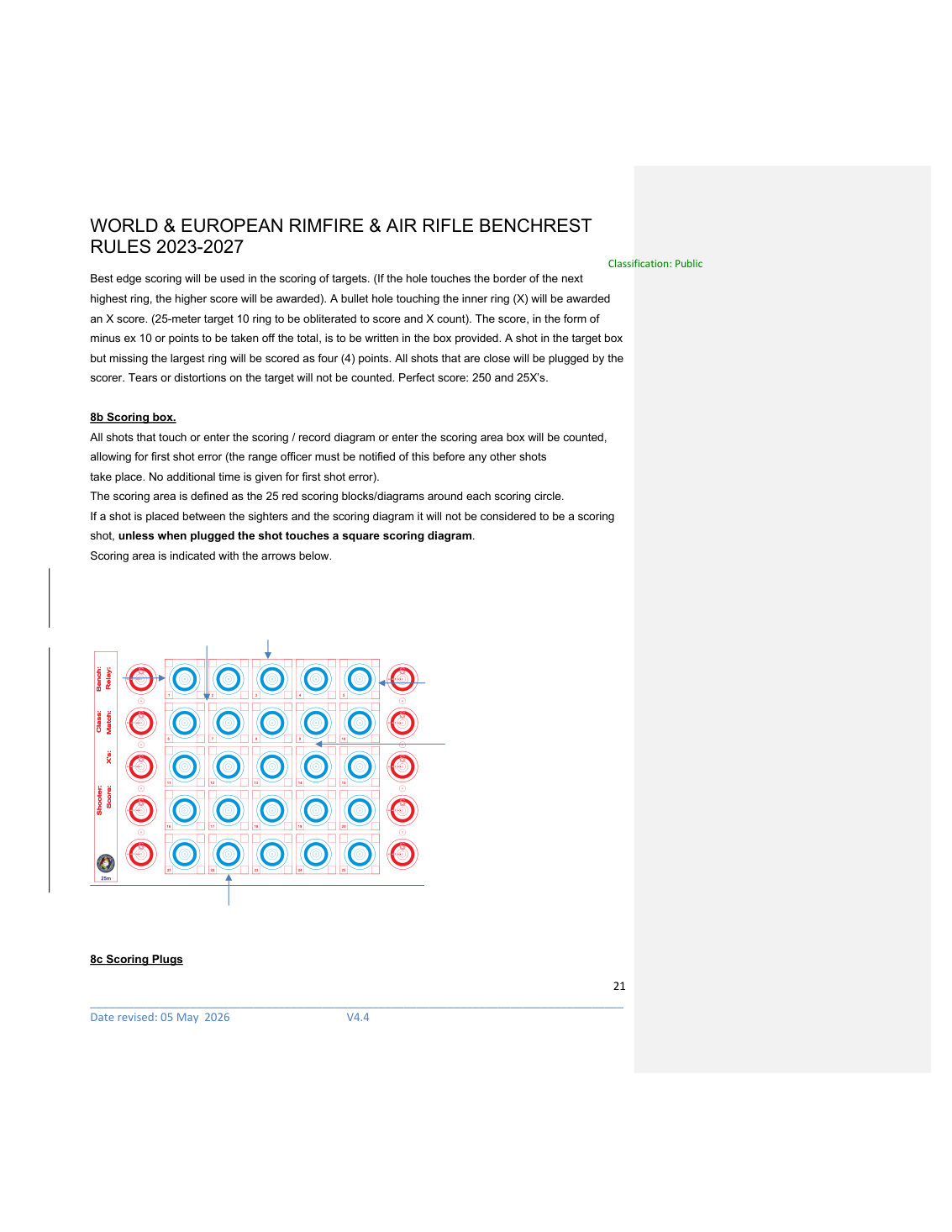
8b Scoring box. All shots that touch or enter the scoring / record diagram or enter the scoring area box will be counted, allowing for first shot error (the range officer must be notified of this before any other shots take place. No additional time is given for first shot error). The scoring area is defined as the 25 red scoring blocks/diagrams around each scoring circle. If a shot is placed between the sighters and the scoring diagram it will not be considered to be a scoring shot, unless when plugged the shot touches a square scoring diagram. Scoring area is indicated with the arrows below.
8c Scoring Plugs All shots which cannot be scored by visual scoring will be checked using a certified .224 plug for rimfire and air rifle - plug and marked on the target with a “P” to so indicate. A Target cannot be re- plugged as part of score query; see C5. Visual scoring only applies to competitions hosted by federations, regions, or clubs. All WRABF/ERABSF Championships targets will be scored electronically. The scoring process is described in Section L.
Plugs for both rimfire and air rifle will be .224. In reference to air rifle so that smaller calibers are not disadvantaged by larger calibers being used.
8d Multiple shots on Targets. Should multiple shots appear in a scoring box, only the lowest score will be counted and will be penalized by subtracting 1 point as a penalty.
8e Shots between target blocks. A scoring block is defined as the diagram that has a red square around is. Should a shot appear between target blocks, the shot will be plugged and assessed for within which target block appears most of the bullet hole. The box with most of the bullet hole will be recorded as having been shot. Where a shot is placed between two target blocks and it cannot be determined to which scoring block the shot should be allocated, the shot should then be allocated to the target to the left, in other word to the target block with the low target number. E.g. If the shot is placed center between e.g. diagram 4 and 5, the score will then be allocated to diagram 4 or if it placed between diagram 5 and 10, the score will be added to diagram 5 If multiple shots impact the scoring box area, as indicated in rule 8b, rule 8d will always apply)
8f First Shot error. If the first shot on paper unintentionally hits a record box, the Range Officer must be informed before the second shot is fired. The Range Officer must visually check the target with a spotting scope and make a note on target when same is recovered. No penalty will be incurred.
8g First Miss (FM). All targets will be scored for FM. The Scorer will check the target box’s starting with the #1 target box. First target box that is not a 10 will be recorded as FM. If target box 1 through 25 are all 10’s (250 score) goes to #1 target box and check X's. The first target box that is not an X will be recorded as FM.
If a tie still exists (250 25X), go to #1 target box and the first X that is not completely plugged out will be recorded as FM. (All FM recorded in the Target Score area and not in target boxes.)
8h Results Printout. After all the results are recorded for a class, a Preliminary Results will be printed. The scorer will then review this printout for any obvious errors and correct them. He will then review the printout looking for any ties the Scoring Program did not break. If any are found, he will note it on the printout and also inform the Protest Committee that a Tie exists. Then they will be posted along with the Targets and labelled Preliminary Results. An obvious scoring error is defined as a clearly incorrect score recorded on a target, which can be Formatted: Highlight unambiguously identified by visual inspection, without requiring plugs, rescanning, or subjective judgment. Examples include, but are not limited to: • A shot visibly touching a higher scoring ring but marked as a lower value; • A missed scoring entry for a shot that is clearly present within a scoring diagram; • A score recorded in the wrong diagram (e.g., score from diagram 5 placed in diagram 6); • A total score that does not match the sum of visible scoring values. Obvious errors must be reported within the protest period. Any person — athlete, team delegate, or official — may raise an alert to the presence of a possible obvious error. If such an error is identified, the Protest Committee or designated Technical Officials may correct it immediately without requiring a formal protest form or fee.
Conditions for correction: The error must be visually evident to a reasonable observer; The correction must not depend on re-plugging or re-scanning; There must be consensus between at least two scoring officials; The correction must be annotated on the target and result sheet as “Corrected due to obvious scoring error” If there is any doubt as to whether the error qualifies as “obvious,” no correction shall be made.
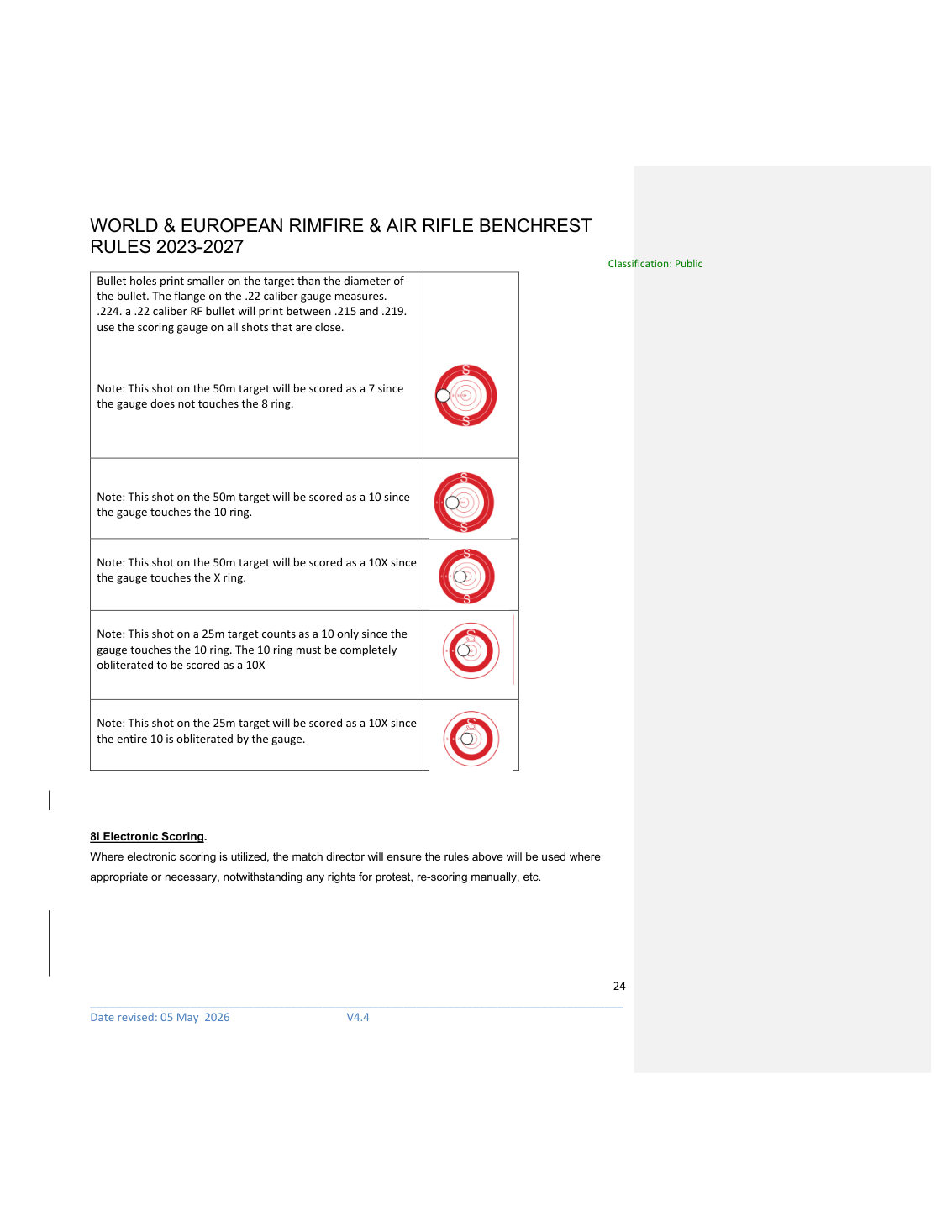
Marking targets and using a .224 scoring gauge Bullet holes print smaller on the target than the diameter of the bullet. The flange on the .22 caliber gauge measures. .224. a .22 caliber RF bullet will print between .215 and .219. use the scoring gauge on all shots that are close.
Note: This shot on the 50m target will be scored as a 7 since the gauge does not touches the 8 ring.
Note: This shot on the 50m target will be scored as a 10 since the gauge touches the 10 ring.
Note: This shot on the 50m target will be scored as a 10X since the gauge touches the X ring.
Note: This shot on a 25m target counts as a 10 only since the gauge touches the 10 ring. The 10 ring must be completely obliterated to be scored as a 10X
Note: This shot on the 25m target will be scored as a 10X since the entire 10 is obliterated by the gauge.
8i Electronic Scoring. Where electronic scoring is utilized, the match director will ensure the rules above will be used where appropriate or necessary, notwithstanding any rights for protest, re-scoring manually, etc.
Section C Protest Procedures & Range Commands
C. 9 Ties: Protest Committee Procedure. C9a Target Ties. (Single Target) Target Ties are broken by Score then X’s then First Miss. If a tie still exists, then FM on X's will be used to break the Tie.
C9b Three Target Aggregate Ties. In a match for one specific class, ties with score and X’s will be broken by comparing the score on the first target - High Score wins and if a tie still exists then the second target score and if a tie still exists then the third target score to resolve the winner. Should after the third target scores are compared and a tie still exists, then FM will be determined on the first target, if a tie still exists then FM on the second target will be determined, if a tie still exists, then the FM on the third target will be determined. Should a tie still exist after considering the above, shooters tying will then be considered to have the same position.
C9c Grand Aggregate Tie. (More than 3 Targets - Teams) Should a tie exist in total score & X’s, such ties will be broken by comparing the score on the first target of the highest scoring shooter (No1) - High Score wins and if a tie still exists then the second target score and if a tie still exists then the third target score etc. to resolve the winner. If a tie continues, then the tie will move onto the second (No2) highest scoring shooter in the team and so forth. Note: For Aggregate Tie Breaks the term “score” is Score & X’s. If a tie still exists, then the term “score” will include FM to break the tie starting from target one and will then move to target two and thereafter to target number 3. Should a tie still exist then FM of the shooter of the second highest score will be determined. If a tie still exists, then FM of the 3rd shooter will be determined. Should a tie still exist after all the above was considered, teams with the same score will then be determined to have an equal finishing position.
C.10 Stationary Backers.
Stationary Backers are desirable but optional. Where they are used these will be located behind the target frames for all matches. These are required to be placed as follows; 3 feet/1m behind target frame.
In the case of crossfires or indecisive targets, these shall not be removed from the frames until the matter is resolved by the Technical Staff. Any fair and appropriate method of using backers will be discussed before the match so all shooters understand their use.
C.11 Standard Range commands – First Match General Instructions.
Prior to each relay of the first match of the day, general instructions shall be announced by the Range Officer. They should be the same or similar to the following, acknowledging local requirements: • “During the match, should an emergency arise which requires an immediate ceasefire, I shall command Emergency – cease fire – unlock your bolts” • This will permit all rifles to be in a safe condition without extracting the case from the chamber. This command will only be given in cases of such emergency that we cannot permit you to clear your rifle by firing. • If a condition should arise which requires temporary suspension of firing, I shall command: • “Hold your fire – clear your rifle by firing or by removing your bolt/ inserting breech flag” Air Rifles should read open your firing mechanisms.” • Do not place any ammunition in the action until the command ‘Commence Firing” •
C.12 Standard Range Commands – Each Match.
To ensure the championship is conducted without confusion, the following range commands are to be used. 1) This is Relay XXX, Match XXX, Class XXX, : Shooters Make Ready! Competitors called to Benches 7 minutes before start to set up rifle and rests, all rifles to be safe, either magazines removed or bolts depending on action.
2) Are Shooters Ready? Competitors do have the option to ask Range Officers additional time to set up (no more than three minutes) if they are experiencing trouble with equipment. Such option will only be granted once during a match.
3) Insert Bolt in Your Rifle/ Remove Breech Flag!
4) You have 20 minutes to complete this match: commence. fire will be a whistle start Commence fire will be a whistle start.
No Competitor to leave the bench seating position until the Match is completed. No competitor will enter the firing line once the Relay has started. They will forfeit that Relay if they are late, and the target will be marked as DNF (Did not Finish). Any shots fired before the whistle start, will result in the shooter being disqualified from the match. If an audio recording is available that will announce the start of the match and the remaining time, the audio recording should be used. Audio should be audible to all competitors. 5) Remaining time will be announced at; 15 minutes, Ten Minutes, Five Minutes, 3 minutes,1 minutes and 30 seconds.
6) Cease Fire will be a whistle stop. Remove bolts from Rifles/ insert Yellow Breech Flag and leave benches. Any shots fired after the whistle stop will result in the shooter being disqualified from the match. All equipment to be removed from bench after guns are checked and put in custody or racks.
Interpretations a) No live ammunition may be placed in the rifle until the Commence Fire command is given. b) Timing commences at the beginning of the word “commence”. c) Timing ceases at the end of the blowing of the whistle. d) Any shots fired before the command “Commence Fire” or after the “Blowing of the whistle” for ceasefire, will result in the shooter being disqualified from, and not taking part in the rest of the day’s shooting.
C.13 Emergency Commands.
In the event of an emergency, the Range Officer will issue a “cease fire” command per C.8. Such command must be obeyed immediately, and no further shots fired. Prior to “recommence firing”, the Range Officer will allow 2 minutes additional time and advise the shooters accordingly, however this allowance cannot exceed the original time for the match. If the match is stopped, three things must happen, all guns made safe, remove bolt / magazine/ insert yellow safety breech flag, etc. and checked. The match will be either abandoned or re-started. If to be restarted no one leaves the Bench except the competitor with the problem, an additional 5 minutes is added to the time remaining for re-setting up rests etc. If abandoned, then the Match will be re-scheduled after a break of minimum 30 minutes. Any shots fired after whistle stop will results in the shooter being disqualified. Note - Voice commands are preferable over a whistle for emergency commands. However, Range Officer to have a whistle in case a stop to the match is required - Cross fire or mechanical fault with a competitor, (or even stray animal, people wandering into range etc, etc.). This will permit all rifles to be in a safe condition without extracting the case from the chamber. This command will only be given in cases of such emergency that we cannot permit you to clear your rifle by firing.
C.14 Protest Committee.
It is the responsibility of the Organising Committee to arrange a Protest Committee to hear any grievances raised by competitors regarding any matters associated with the conduct of the championship.
C.15 Composition of Protest Committee.
The Protest Committee shall consist of the Championship Director, and four experienced competitors (not from the host country) appointed from those entered. It is preferred that competitor appointees are changed daily for the period of the championship. Alternatively, the Organising Committee may appoint a Technical Committee of experienced individuals to act as the Protest Committee, who are not competitors and who have the ability to act independently of competing teams.
C.16 Lodging Protest.
All protests are to be lodged on the prescribed form (see Appendix Form A) together with a Protest Fee of $20US/€20 or equivalent local currency. In the event of a successful protest, the fee will be refunded in full; otherwise, all fees will be retained by the Organising Committee. All Protests must be submitted within 30 minutes of the alleged grievance or posting of the last target of the specific class of. Any disqualification (DQ) a reason should be given in writing to the team delegate and 1 hour to request a review of the decision
C.17 Decisions of Protest Committee.
The decisions of the Protest Committee are final and binding and there is no provision for appeal of such decisions.
C.18 Sportsmanship
There shall be no boisterous conduct on, or near, the firing line during the firing of any match. Everyone shall treat all shooters as they would like to be treated if they were about to shoot a new record score. If competitors cause a disturbance, a protest may only be lodged by the competitor which may lead to disqualification or a warning. Competitors who have a grievance must ensure the Match Director, Referee, or Range Officer is aware. They will determine what course of action to take. Disturbance can be seen as:
a. Mobile phones going off. (No mobile phones are allowed on the range) b. Moving from the firing line when shooting relay has not finished. c. Conversations with people on the firing line or spectator area while competitors are shooting. d. Cleaning of rifles except in designated cleaning areas e. Major adjustments of rifles. f. Coaching shooters, in all its forms g. No competitor should enter the firing points once the match has started. If they have missed the start of the match/ relay they forfeit that relay, as this will cause a disturbance to other shooters. h. Major adjustments will not be allowed, minor adjustments such as adjustments on the tuning device are allowed only from sitting position and rifle stays pointed in target direction. This list is not exhaustive. I. Competitors must remain seated until the end of each relay. No competitor should enter the firing points once the match has started. If they have missed the start of the relay they forfeit that relay, as this will cause a disturbance to other shooters. The above applies to spectators, who will be asked to keep noise to a minimum and if continued they will be asked to leave while shooting continues. Spectators will not be in the shooting area under any circumstances and must not engage in conversation with competitors on the line, whether they are shooting or not. alcohol and substance abuse is not tolerated in any sport. If a competitor is considered to be intoxicated in any way, they will be removed from the firing line and will be tested for intoxication. If proved positive, they will be disqualified – see below. (PLEASE DO NOT DRINK BETWEEN MATCHES OR WHILE ON THE SHOOTING RANGE) k. Additional air bottles – there should be no changing of buddy bottles for the AR Unlimited class and if issues arise with the bottles competitors should not be allowed to alter, change or fix during the match to the detriment of other competitors. l. Competitors should not leave their seats during a match unless in an emergency
C.19 Disqualification
Where a competitor has been disqualified for a particular reason, this DQ will last for the day they are shooting a specific class in the championship. If they are a member of a team, that team will also be disqualified by default. The person being disqualified (DQ’d ) will be provided with a noted official warning to ensure further issues do not arise during a championship. It is noted that a full disqualification (DQ) from the championship would be taken as a last resort, but the organizing committee reserve the right to warn competitors of this action if issues persist during the event.
SECTION D Approved Events and Time Limits
D.1 Approved Events.
The approved events for conduct at the World Rimfire and Air Rifle Benchrest Shooting Championship are as detailed:
D.2 Mandatory Events (depending on entry numbers to events, below is a suggested itinerary only – the
match director can outline the order of events with 25m first and 50m second, or what is suitable for the specific range where the championship takes place). As per rule E.4 a maximum number of 12 relays per day will be shot with a maximum of 4 relays per Target. Day 1 LR Air Rifle Championship - 25m - Targets No 1 & 2 & 3 Day 2 HR Air Rifle Championship – 25m Targets no 1 &2 & 3 Day 3 50m Unlimited Championship - Targets No 1& 2 & 3 Day 4 Int. Sporter Rimfire Championship – 50m - Targets No 1 & 2 &3 Day 5 LR Rim Fire – 50m - Target 1 & 2 & 3 Day 6 HR Rimfire Championship – 50m - Targets No 1 & 2 & 3
Note. Air Rifle in all circumstances will be shot first. Classes must be contested in the following order: First: International Sporter, Second; Light Rifle and Third; Heavy Rifle weight Class. A Practice Day should also be established within this event calendar for both Air Rifle and Rimfire (possibly after the air rifle events or even during the whole championship). Weigh in before the event starts.
Optional events. With the rapid growth of the unlimited air rifle class all over the world, these classes can also be shot during a competition, and it is the decision of both the WRABF/ERABSF and organizing committee if these classes will be shot.
D.2a Metric Alternative. See Section A.9 D.2b Warm-up Match. A warm-up match will be conducted on the first day of competition. If time is restrictive warm up or practice during the championship can be eliminated at the Match Director discretion.
D.3 Time Limits.
Score matches - the time limit will be 20 minutes. There shall be no exception to the requirement for all competitors to complete their string of fire within the time allowed.
D.4 Subsequent Relays
Not more than 20 minutes shall be allowed between the end of one match of championship match and the start of the same relay in the next match. The Range Officer will call competitors to the line at least ten minutes before the commence fire command is to be given, to allow rests and other equipment to be set and adjusted.
Section E Technical Provisions.
E.1 Range Officers.
In the selection of technical and volunteer staff, special consideration must be given to the competence of Range Officers and their knowledge of these rules. It is preferable to seek well experienced individuals who have a known ability to conduct the matches in a manner compatible with the event. Emphasis should be placed on the ability to administer issues such as crossfire’s, target system failures etc. Each range officer or safety officer will use the Range Officer and Competitor Safety Guide.
E.2 Squadding Procedures.
Allocation of positions on the firing line for the championship will be drawn by ballot, immediately following the Closing Date for final entries on the following basis: Ballot will be for Teams spread evenly amongst available benches. It will be for each Team Leader, at the time of final entry, to advise allocation of their team’s individual shooting order. If no such advice is forthcoming, the Organising Committee will undertake allocation at their discretion. In the event of competitors being nominated without involvement in a Team, each will be allocated any available benches or positions at the discretion of the Organising Committee.
E.3 Bench Rotation.
Bench rotation shall be mandatory. If required, a drawing for bench assignments will be made before the first match of the day. Any fair and reasonable method shall be allowed. The rotation system to be used is to be advised to all countries at the time of seeking entries. Should a country wish to adopt a system not previously used at the World Rimfire and Air Rifle Benchrest Championship, consultation with the WRABF President must be undertaken so a consensus view can be sought. It is preferred that the rotation over the six days of competition be consecutive. i.e.: over the period of the championship shooters move across the full width of the range.
E.4 Relay.
Twelve (12) Relays of 20 minutes should be the maximum programmed for one day, to allow for orderly competition.
E.5 Unfinished Aggregates.
In the event that any aggregate is uncompleted on the scheduled day, the aggregate will continue the next morning where it was left off.
E.6 Results Service.
There is a need to provide a timely and accurate results service to the competitors. It is compulsory that an accurate electronic scoring program be used to process the results to ensure an adequate style of presentation and accuracy. However, a hard copy of all results is to be maintained in the event of computer failure. Scoring should be done in a private and secure area, restricted to official technical staff only. All targets marking should be conducted by at least two delegated Technical Officials, one to undertake primary marking using approved equipment. Target score to be displayed on the face of the target. A scoring plug is to be used at all official matches. Appointed by the Match Director to score targets, the Score Officer(s) must use the same plug for the entire competition. The plug for all classes shall be a .224 scoring plug.
E.7 Results Posting.
Adequate notice boards are required to post results progressively during the competition. Such should be easily accessible both to competitors and the public. No competitor or persons from the public are allowed to touch any target until 30 minutes at the end of the championship day has lapsed. It should be clearly stated in the Championship instructions, where Official Results will be posted to ensure no confusion over protest requirements. Aggregate results so posted shall have included on the results the exact time of posting and the time of the expiry of protest rights (15 minutes) Championship scores and records will be recorded electronically on the appropriate websites; National, continental and the WRABF/ ERABSF websites.
Note. The organizers of an event will appoint a scoring group for the final scoring of proposed new records. Such groups can meet in person or by correspondence. All targets that constitute the record shall be made available to the ‘scoring group’ by the shooters Team Captain. Independent scoring by WRABF/ ERABSF official scorers. The group(s) shall personally inspect and independently re-score each target, providing to the General Council and nominee the results of their efforts. It will be for the President of the WRABF/ ERABSF to announce any new records via appropriate websites. There shall be no appeal rights available as a result of scoring.
E.8 Inspection Area.
It will be necessary to establish a facility for the implementation of inspection procedures to ensure firearms are in compliance with these rules. The equipment to be used for inspection should be available at least two days prior to competition, to ensure individuals have an opportunity to test their equipment to ensure compliance with these rules.
E.8.1 Manpower Requirements.
Inspections should be carried out by staff that are fully familiar with the rules.
E.8.2 Documentation:
It is desirable that a standardized inspection form be used to provide consistency and be recognizable to range staff if further inquiry is required. See Appendix E for suggested form.
E.8.3 Certification Sticker/s.
An Inspection / approved sticker, which are suitable for attachment to the rifle, are to be available. These should be unique to each championship and retained under security.
E.8.4 Certification Equipment.
The following list is recommended. § Rule (Tape Measure) or rifle size template. § Gauge to measure stock width. The gauge in case of a size template must be exactly 1mm bigger than the allowable stock width. § Gauge to measure bottom of the stock width. The gauge in case of a size template must be exactly 1mm bigger than the allowable stock width. § Calibrated Weighing Scales (preferably electronic) with a rated capacity of 10kgs. § Chronograph to measure the effective energy of pellet in joule (ft/lbs.), or speed for all Air Rifles.
E.8.5 Inspection Mandatory.
All competitors must present at the subscribed time, all rifles intended to be used in the Championship for inspection. Failure to do so will mean disqualification from that event.
E.8.6 Inspection Failure.
Rifles that fail inspection may be re-submitted for re-inspection following any adjustments, but prior to commencement of competition.
E.8.7 Weight Allowance for each class.
View original PDF tables / diagrams (pages 35)
All guns are to be weighed before the match begins so no one will get a rude surprise if their equipment is found to be overweight. If a rifle is found to be overweight after a match is completed, the score must be reported as "DQ" (same as any other disqualification). It is also recommended that the guns of all winners of prizes, be weighed. At the time of weighing, an additional allowance of 28g or 1 ounce will be granted for possible inaccuracy / calibration of the scales. An Inspection/approved sticker, which are suitable for attachment to the rifle, are to be available. These should be unique to each championship and retained under security. An area for weighing and inspection should be available at the venue.
E.8.8 Random Inspection.
At the discretion of the Championship Director, shooters may be required to resubmit their rifle/s for re- inspection at any time during the Championship. The Director is not required to give advance notice of such inspections. If Officer(s) verifies that any element of the equipment, already submitted to preliminary control, are altered, or replaced, the competitor will be immediately disqualified for the whole match or, in specific cases, for the whole championship.
E.8.9 Air Rifle Power Check Procedure
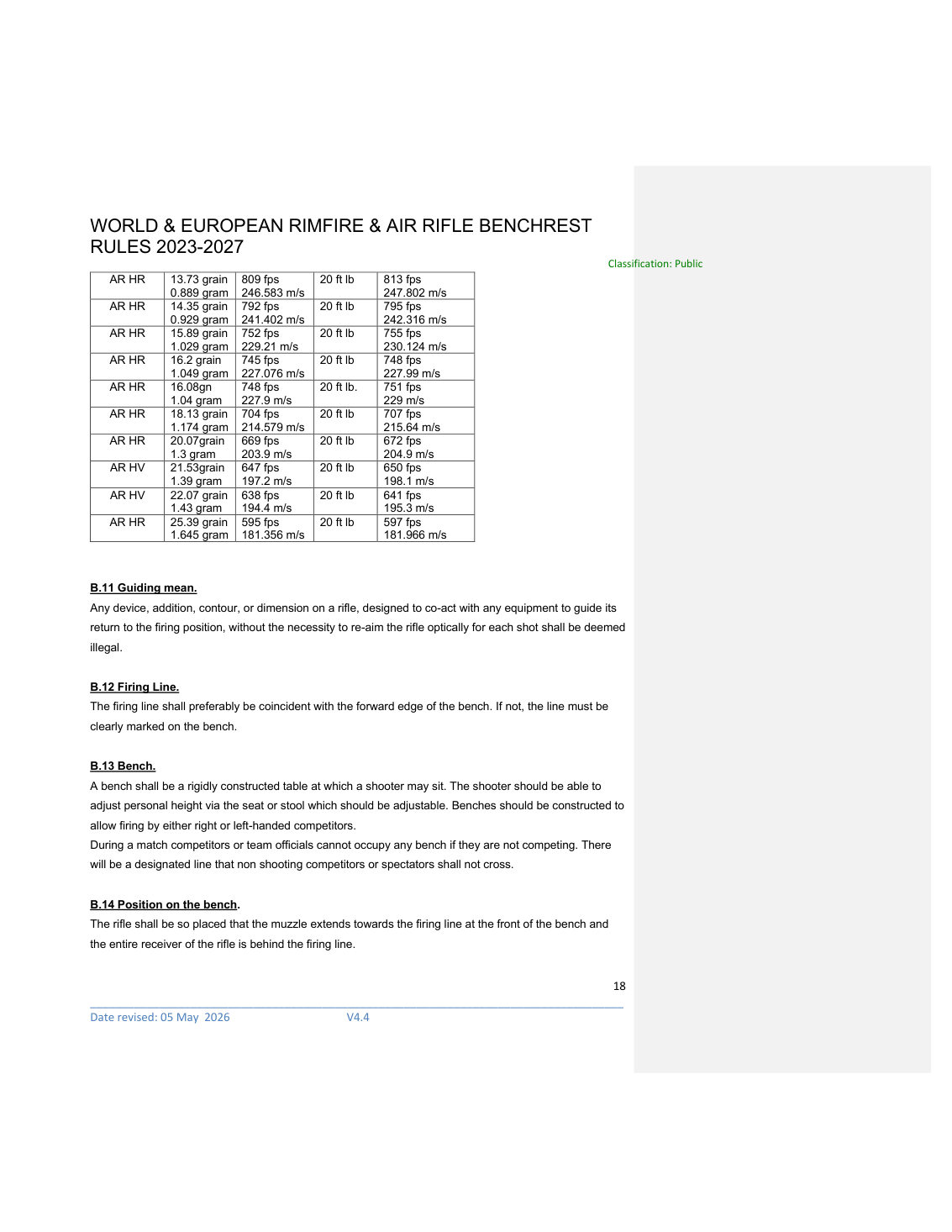
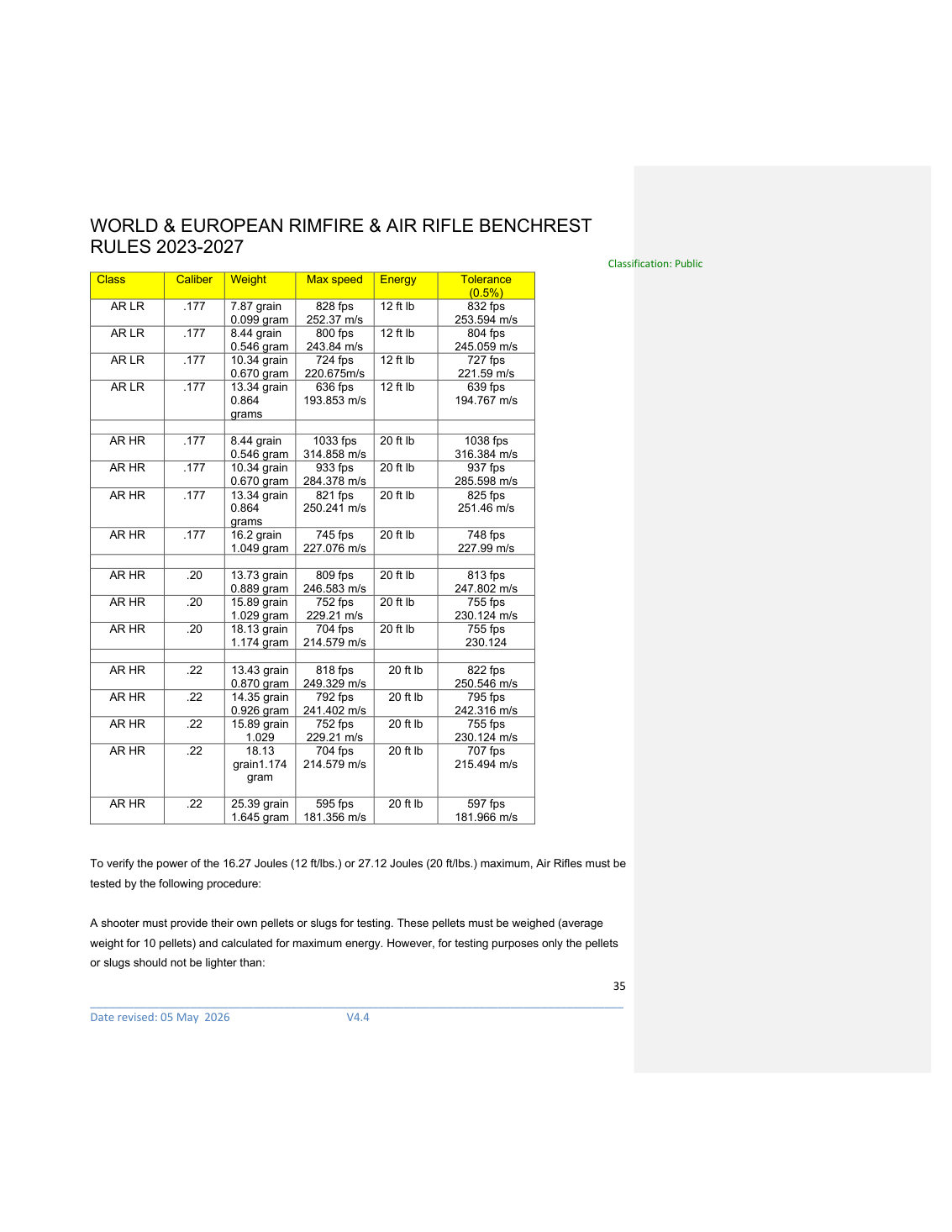
Air Rifle power will be checked before the match so there should be a suitable chronograph system available at each event. A competitor must chronograph the air rifle with the pellets or slugs that will be used by the competitor during the competition. A sequence of 5 shot to be measured by a chronograph (averaged velocity of 5 shots). Minimum pressure in competitors air cylinders will be 190 bar before the test can take place. As current high-quality chronographs state an accuracy level of 99.5%, a 0.5% +/- tolerance level will be allowed. Kinetic energy (ft/lbs.) = weight (grains) x speed (ft/sec) x speed (ft/sec)/ 450240 or Energy (Joules)=weight (kilograms) x speed (m/sec) x speed (m/sec)/2 Class Caliber Weight Max speed Energy Tolerance (0.5%) AR LR .177 7.87 grain 828 fps 12 ft lb 832 fps 0.099 gram 252.37 m/s 253.594 m/s AR LR .177 8.44 grain 800 fps 12 ft lb 804 fps 0.546 gram 243.84 m/s 245.059 m/s AR LR .177 10.34 grain 724 fps 12 ft lb 727 fps 0.670 gram 220.675m/s 221.59 m/s AR LR .177 13.34 grain 636 fps 12 ft lb 639 fps 0.864 193.853 m/s 194.767 m/s grams AR HR .177 8.44 grain 1033 fps 20 ft lb 1038 fps 0.546 gram 314.858 m/s 316.384 m/s AR HR .177 10.34 grain 933 fps 20 ft lb 937 fps 0.670 gram 284.378 m/s 285.598 m/s AR HR .177 13.34 grain 821 fps 20 ft lb 825 fps 0.864 250.241 m/s 251.46 m/s grams AR HR .177 16.2 grain 745 fps 20 ft lb 748 fps 1.049 gram 227.076 m/s 227.99 m/s AR HR .20 13.73 grain 809 fps 20 ft lb 813 fps 0.889 gram 246.583 m/s 247.802 m/s AR HR .20 15.89 grain 752 fps 20 ft lb 755 fps 1.029 gram 229.21 m/s 230.124 m/s AR HR .20 18.13 grain 704 fps 20 ft lb 755 fps 1.174 gram 214.579 m/s 230.124 AR HR .22 13.43 grain 818 fps 20 ft lb 822 fps 0.870 gram 249.329 m/s 250.546 m/s AR HR .22 14.35 grain 792 fps 20 ft lb 795 fps 0.926 gram 241.402 m/s 242.316 m/s AR HR .22 15.89 grain 752 fps 20 ft lb 755 fps 1.029 229.21 m/s 230.124 m/s AR HR .22 18.13 704 fps 20 ft lb 707 fps grain1.174 214.579 m/s 215.494 m/s gram AR HR .22 25.39 grain 595 fps 20 ft lb 597 fps 1.645 gram 181.356 m/s 181.966 m/s
To verify the power of the 16.27 Joules (12 ft/lbs.) or 27.12 Joules (20 ft/lbs.) maximum, Air Rifles must be tested by the following procedure:
A shooter must provide their own pellets or slugs for testing. These pellets must be weighed (average weight for 10 pellets) and calculated for maximum energy. However, for testing purposes only the pellets or slugs should not be lighter than:
• 8.44 grain/ 0.547 gram for LR class for caliber 0.177 • 13.34 grain/0.864 gram for LR class for caliber 0.177 • 10.34 grain/ 0.67 gram for HR class for caliber 0.177 • 13.73 grain/ 0.89 gram for caliber 0.20 (for all classes) • 15.89 grain/ 1.03 gram for LR class for caliber 0.22 • 18.13 grain/ 1.175 gram for HR class for caliber 0.22mm
Caveat - If there is a consistent problem with testing using standard pellets above – due to poor light/ heat or another issue that may affect the chronograph/ or by nomination - the competitor can elect, with the match director’s permission, to have the same test procedure (as noted above) but using their own pellets, working within the above rules. This procedure will take place after all other testing has taken place, or when available before the first match.
E.8.10 Rifle and/ or Equipment Conformity
In case of nonconformity of rifles and equipment noticed by Weapons & Equipment Check Officer(s), competitors do have the possibility to replace it or adjust his / her rifle / equipment but are only allowed up to 15 minutes before the start of the relay / match. Competitors can also forward a claim to have the said equipment/ rifle admitted by applying in writing to Championship Referees who will make a final decision. If this is not done in time for the start of the relay, the Range Officer has the right to admit the shooter with the purpose of not hampering or to slowing down the beginning of the competition. In this situation the Match Director will make a final decision at the end of the relay/match whether the equipment/ rifle is allowed under the rules. If this is not the case the rifle / equipment will be disallowed, and the competitor disqualified for that relay / match. It is the responsibility of the competitor to ensure that all rules are understood, and clarity is sought if they are not.
Inspection Procedure Formatted: Font: (Default) Arial, 10 pt, Underline, Not Highlight During rifle inspection: Formatted: Space Before: 0 pt, After: 0 pt, Line spacing: • The rear rest must be demonstrated to yield under finger pressure. 1,5 lines Formatted: Font: (Default) Arial, 10 pt, Not Highlight • The rifle must be shown to lift vertically or slide horizontally without resistance. Formatted: Font: (Default) Arial, 10 pt, Not Bold, Not Highlight Formatted: Font: (Default) Arial, 10 pt, Not Highlight
E.9 Scoring Error.
Where a competitor considers an obvious error has been made, a request can be made of the Target Marking Officials to view the target or result sheet and have the matter resolved. Where there is doubt, the competitor can submit a formal protest in accordance with the Protest Procedures.
E.10 Target re-score Procedure.
Once a target was scored electronically, the target will not be rescored. The only way to is through a protest of a target diagram, where the specific diagram will be plugged by the protest committee.
E.11 Removal of Bolts.
All rifle bolts must be kept out of all rifles, except on the command of the Range Officer. Rifles that are unable / do not have bolts to be removed, must have inserted into the chamber yellow breech flag that visibly shows that the chamber is empty. This provision includes behind the firing line and in all other range areas including Competitor Facilities, Parking areas etc. Breach of this rule could lead to disqualification from the championship at the discretion of the Championship Director.
E.12 Cross fire procedures.
It is the responsibility of the shooter who crossfires to immediately advise the Range Officer of such an event, and then fire the balance of their shots on their own target. A shooter who crossfires and does notify the range officer, will have been deemed to have inadvertently cross-fired and shall not be disqualified, but shall be penalized as per E.12.2. Only the required number of shots are counted on the cross firer's own record target plus the penalty for each cross-fired shot.
E12.1 Crossfire transfer.
A notified crossfire will be transferred to the correct target and included in the match score with a penalty of 5 points.
E12.2 Crossfire Penalty.
Target diagrams of the cross-firing shooter will be penalized with 5 points for each cross fired shot. (5 points per crossed fired shot). If the cross-fired shot cannot be identified (2 shots on target) the innocent party will be awarded the highest scoring shot registered on their target.
E12.3 Innocent Party.
The competitor, on whose target a crossfire has been placed, is obliged to advise the Range Officer of such a happening.
E12.4 Failure to Notify.
Any shooter found to have cross-fired, and not notified the Range Officer, and whose target shows more than the required number of shots, with the inclusion of crossfires to another target, shall be deemed to have tried to conceal the fact and shall be disqualified from the event.
E12.5. Nomination to re-shoot.
The innocent part can nominate to re shoot the same bull after the range officer has inspected the cross fired shot or may elect to shoot a nearby sighter as a recorded bull again. Advice must be given to range officer so they can notarize this.
E.13 Wind flags.
Wind flags can be utilized that are present at the venue and competitors can bring their own. Flags must be no higher than level of bench top to bottom of target. Organizers must place enough wind flags in position before match begins. It may be possible for wind flags to be moved or taken down after each relay (target) is completed, depending on the nature of the range where the championship is taking place – if so, time will need to be allocated for this during each day’s matches. Bench rotation will need to be considered to facilitate this process. If a flag is in a shooter’s line of sight, the Range Officer / Referee will lay the flag on the ground. This must be done before match commences. For clarity moving flags is under the control of the Range Officer and may not interfere with the orderly conduct of the match. The use of electronics in all forms is strictly prohibited in all rifle classes and this includes electronic wind flags.
E.14 Rifle fault during the match
A change of rifle is permitted during the competition if there is a proven fault with a rifle, especially when this relates to safety, and it is considered dangerous. In this case the competitor will ask the Range Officer to view the rifle and possibly replace it with a new one. The Range Officer may authorize the change of weapon with a rifle of the same class, after which the faulty rifle will be dispatched for inspection by Weapons & Equipment Check Officer(s). (The Range Officer will need to decide if the match can continue or needs to be stopped depending on the how serious the fault is and if changing rifle will infringe on the shooters who are continuing with the match). No extra time will be allowed for competitors when this situation occurs, and they will not be allowed to re-shoot the relay. If inspection confirms the fault, then, after the end of the relay, the shooter will keep the score achieved with the new rifle. If the fault is manufactured by the competitor to gain advantage, or the responsibility of the competitor due to negligence, an automatic DQ from the match will be applied.
SECTION F Range and Facilities 25 Meters / 50 Meters
F.1 Minimum Range facilities for conducting a World or European Rimfire and Air Rifle
Championship Tournament. § The firing line shall consist of not less than FORTY (40) benches/tables. § There shall be sturdy target frames at both 25m and 50 m. § There shall be adequate covered area for all competitors to protect the competitors from direct sun and rainfall and spacing to allow adequate comfort both right and left-handed shooters. Covered shooting area does not constitute an indoor range if targets are still in open air. § All 25m ,50m matches will be undertaken outdoors. § There shall be enclosed facilities for statistical personnel. § There shall be adequate covered area for display of completed targets. § There shall be adequate sanitary facilities for competitors (Male, Disabled and Female), technical staff and spectators, with provision for disabled participants.
F.2 Range Inspection and Certification.
It will be the responsibility of the host association to ensure that the range and facilities are of a standard suitable for the conduct of the Championship and have appropriate insurance. It will be for the host country’s International Delegate to provide assurance to the Delegates Committee that these requirements have been met. In the event of doubt or concern, it will be for the Delegates Committee and / or President to appoint a suitable person to undertake a pre-championship inspection to ensure all standards are being met.
F.3 Range – Benches.
The range must be equipped with adequate benches to cope with the numbers expected at the Championship. No international standards have been developed on size, spacing etc. however the Delegates Committee needs to be satisfied fair and equal competition will be offered. Benches must be covered by roofing to protect the competitors from direct sun and rainfall.
F.4 Minimum Competitors.
There must be a minimum of thirty competitors for a European or World Championships, representing at least five countries, with a minimum of one individual competitor representing each country. For a country to place a team in the competition they must have at least three competitors.
F.5 Maximum Competitors.
Each country can enter a number of competitors for each event/match in the Championship, including juniors – this however depends on the allocation of places the country is provided by the Match Director/ Organising Committee. (To clarify, at some competitions a country may be allocated 6 places, at another they may be allocated 9 or more. This will depend on the number of benches available and the number of other countries attending).
F.6 Teams.
There must be a minimum of two countries with teams entered into a match for a team result to be shown, with at least three teams entered from those two countries. Each country can enter up to three teams of three in each match/ class.
F.7 Relays.
All competitors on each relay, if possible, must be contesting the same class. If time is restrictive and numbers in classes are low, then mixed classes on each relay can be organized at the Match Directors discretion.
Note: 12 (Twelve) relays per day will be the maximum programmed to allow for orderly and fair competition. Three targets will be shot by each competitor in one day for each allowed Class in bench rotation, the aggregate being the score submitted and that will form the basis of a “World Ranking” within the Sport. Main events must have a car park inside for visitors with campers and cars with range emergency access; possibility to store rifles and equipment in a protected area during the competition; separate area for Scorer and Technical Officers; adequate covered area for display of completed targets and finally a covered separate area for rest and relaxation of Competitors. It will be the responsibility of Organizers to ensure that the host range and facilities are of a standard suitable for the conduct of the match/championship. The WRABF/ ERABSF will appoint a suitable person to undertake a pre-championship inspection to ensure all standards are being met.
F.9 Toilet Facilities.
The provision of both male and female toilets is required at all sites within reasonable walking distances of the range facilities with provision for disabled athletes.
SECTION G Ceremony, Meetings and Medal Distribution
G.1 Medal Ceremonies.
It is for the Organising committee to arrange the style and venue for medal ceremonies to suit their own facilities. These will be held at the end of all the Air Rifle classes and at the end of the RimFire classes.
G.2 Opening Ceremony.
An opening ceremony is an excellent opportunity to promote the sport in front of invited guests, and equally sets the stage for competition. It is suggested that early consideration be given to a list of guest speakers who are important to the sport. Politicians, City Officials etc. often need to be booked several months in advance. It is normal practice, that such an event would be staged on the opening morning of the competition however alternative options could be explored. The style and content of the ceremony is at the discretion of the host association. A Competitors pin will be given out to each participant at the end of the opening ceremony.
G.3 Closing Ceremony.
The style and format of a closing ceremony / function should also be considered. It is generally recognized that a semi-formal function should be arranged. It is recommended that during this function, the teams from each country should be presented to the function as an acknowledgment of their participation.
G.4 Other Functions
Any additional functions are at the discretion of the Organising Committee.
G.5 Meetings
Meetings are required as follows: Technical Meeting: This to be held at the range, if a suitable venue is available, at least 24 hours before the commencement of competition. There will be a technical meeting for both AIR RIFLE and RIMFIRE, before the separate matches begin. The purpose of the meeting is to ensure critical staff and Team Officials are briefed on final arrangements for the Championship, and to deal with any concerns. The following people are required to attend: • All Delegation Leaders and interpreters as required. • All Technical Staff.
Other Team Officials/Coaches – optional. • See Appendix F for Agenda. (Note: This meeting is not designed for competitors.)
WRABF/ ERABSF General Meeting This meeting is usually held about midway through the Championship. This should be planned to be away from the range at an easily accessible venue. (Team Accommodation or similar). This should not be planned to commence before 7.30pm.
G.6 Medal Distribution.
The following list of medals/Awards is to be presented at each Championship for each class. Senior Individual to the top three in each class / event - Gold, Silver, Bronze. (18 medals if the unlimited class is also shot.) Teams to the top three teams in each class / event - Gold, Silver, Bronze. (54 medals if the unlimited class is also shot) If there are sufficient junior competitors, the following would also apply; Juniors Individual to the top three in each class / event-Gold, Silver, Bronze. Subject to minimum of three entrants in each class applicable. This does not prohibit junior shooters from winning medals in the senior individual section or from being members of teams. If this occurs, they will get two medals. If there are insufficient Junior entrants to enable to medal place, entrants will be combined into a Senior overall Individual Award.
G.7 Awards:
Grand Aggregate Individual Championship based two-gun aggregates – air rifle LR and HR Grand Aggregate Individual Championship based two-gun aggregates – rimfire LR and HR Grand Aggregate Individual Championship based three-gun aggregates - rimfire Int.Sp, LR and HR Grand Aggregate Individual Championship based on 5 gun aggregates Air Rifle LR and Air Rifle HR, RF IS, RF LR and RF HR - this is at the organizers discretion. Grand Aggregate Individual Championship based on 6 gun aggregates Air Rifle LR and Air Rifle HR, RF IS, RF LR and RF HR and Air Rifle Unlimited(50m) - this is at the organizers discretion.
G.8 Discretionary Awards
• At the discretion of the Organising Committee, the provision of Top 10/20 Patches may be awarded. • 250 pins will be awarded for those scoring 250 on a target in Air Rifle 25m or RimFire 50m. Should the Unlimited class be shot at 50m, 250 pins should also be awarded.
Awards are also suggested for: • Junior prizes and senior prizes as specified by the Executive Committee.
G.9 Participation Award
The Organising Committee should provide a suitable medal or patch to all registered competitors as an acknowledgment of participation. Participation certificates may also be provided for all people who complete the championship. Championship patches, T shirts or other merchandise can be offered to participants on a purchase basis – funds will go to WRABF/ERABSF and/or the host of the championship.
Section H Entry Fees and Registration
Registration Match / relays will commence at the designated times set out in the programme of events which will be circulated to all competitors upon registration. Registration will close before the event commences. Countries will register required places first. Initial competitor registration forms are to be filled out and signed by each competitor and submitted by their national organization for both individuals and Teams. The final registration will have a set deadline before the event to ensure clarity. Names of competitors can change, but no further entries will be made after the close of registration. Fee payments are to be made no later than one day before the championships / match commences. It is the responsibility of the national organizations to ensure registration fee payments are made in full on or before the due date on behalf of all shooters from that Organization. Payment will only be accepted from individuals in exceptional circumstances. All Competitors to sign in with Name, Class, Gun, Caliber, and License Number. An individual competitor number will be issued that will be placed on each target. Competitors are responsible for ensuring they know the number of the target they are using.
H.1 Entry Fees.
It is the responsibility of the Organising Committee to publish at least 12 months in advance the level of reasonable entry fees to be charged. International delegates must agree on costs.
H.2 Responsibility for Payment of Entry Fees.
It is the responsibility of the recognized organizations to make entry fee payment in full before the due date on behalf of all shooters from that Organization. Payment will not be accepted from individuals. Individual registration is payable per class entered. Team registration is free.
H.3 Practice Fees.
Costs for official practice days are to be included in the entry fees for each championship event. Unofficial practice costs can be charged separately at the discretion of the organizing committee. All practise fee arrangements are to be advised in the entry information.
H.4 Late Entries.
The acceptance of late entries is at the discretion of the Organising Committee. The acceptance of late entries must not disadvantage those countries that have met the entry deadlines. The Organising Committee is authorised to charge a penalty rate for late entries.
Section I Range Safety and Procedures
Safety of Competitors, Officials and Spectators is considered paramount. It is the responsibility of all participants to ensure that all safety standards are complied with, and breaches will not be tolerated. The Match Director, Range Officer or WRABF Officials will be responsible to see that appropriate safety precautions are taken. It is expected that the Match Director and all competitors will exercise their best judgment to keep our sport safe for all that participate. The Range Officer to go over basic safety rules if appropriate before a match if there is any question that anyone in attendance may not be familiar with the rules in effect at that range. Team Leaders / Team Captains even if they do not compete have a responsibility to ensure all participants comply with this requirement. Please see Sportsmanship rule C18i about intoxication and substance abuse on the shooting range.
I.1 Range Officer.
It is the responsibility of the Range Officer/s to supervise all matches and enforce all safety rules. Refusal to comply with a safety order of the Range Officer shall be grounds for barring a competitor from the range. Disqualification may result if these procedures are not followed. A range officer may disqualify a competitor for contravening any rule set out in this WRABF rules document. Should the range officer disqualify a competitor, the competitor should be given the opportunity to complete the relay he/she is busy with. This will allow the competitor to lodge a protest against the disqualification. Range officers should caution against disqualification of competitors other than range safety.
I.2 Standard set of commands.
Range Rules at each facility may vary from country to country. It is the responsibility of the Organising Committee of each Championship to ensure any individual requirements that may apply are advised to participants. However, as a minimum, a standard set of commands are provided (see C11 and C12)
I.3 Public Areas.
It is the responsibility of each individual shooter to ensure movement around public areas with firearms, is conducted in a safe and appropriate manner. Team Leaders have a responsibility to ensure all participants comply with this requirement. All rifles must be in a bag or case.
I.4 Recognized safety rules will apply.
4a All Rifles, having a safe manually and mechanically or electronic operated firing mechanism, must be equipped with trigger guards.
4b Firearm movement around public area has to happen in a closed custody. This provision includes behind the firing line and the other common range areas like competitor facilities, parking areas etc.
4c Rifles are NEVER to be on the bench until the Match Director calls the relay to the line after determining that the range is secure. When anyone is down range, NO RIFLES will be allowed on benches.
4d At all times at the range all rifle bolts must be kept out of all rifles, except on the command of the Match Director. Rifles that are unable / do not have bolts to be removed, must have a device inserted into the chamber that visibly shows that the chamber is empty. (Bolt can be inserted or flag stop-bolt removed only following the command “Insert Bolt in Your Rifle!” by the Match Director.)
4e Under no circumstances will a shooter load a round into a rifle before “LOAD” command.
4f Firearms and equipment cannot be removed from the bench before the term of the match, authorization excepted by Match Director. The shooter that has to abandon the bench during the competition, even if momentarily, must have been cleared only by the Match Director or Range Officer, and leave the weapon on the rest, bolt removed or with the yellow breech flag inserted. At the end of the relay the competitor must declare his/her rifle safe to the range officer and show his/her rifle bolt.
Section J Competitor Requirements:
J.1 Official Language.
The official language of the Championship shall be English, and all commands and instructions shall be provided in that language.
J.2 Competitor Number.
Each competitor shall be provided with an individual competitor number and country identification, suitable for attachment to competition clothing. Such Identification must be worn and be always visible while the competitor is at the firing line.
J.3 Name Tag.
Each competitor should be provided with a name tag that includes Name, Country and competitor number that can be used for identification purpose on the range and at functions.
J.4 Official Notice Board.
The Organising Committee will establish an official notice Board and its location advised to competitors and officials. All official communications must be posted on this board to ensure all participants are equally informed.
J.5 Disabled Competitors.
The WRABF and ERABSF positively supports the participation of disabled shooters in their championships. No specific limitations are mandated; however, organizing committees must be mindful of access and toilet requirements. Should a participant require special permission due to physical disabilities, application should be made in writing to the President or nominee in sufficient time for a decision to be made.
Section K Officials and Duties
General Any person may hold more than one Championship Official position. When possible, it is suggested that matches be scheduled such that persons holding the Official positions may also be able to compete in the matches. All rules apply to Officials / Range Officers etc. Officials to be as follows: Match Director; Range Officer; Weapons & Equipment Check Officer; Score Officer and Referees.
Definition and Duties
K.1 Match / Championship Director.
The match/championship director is the manager delegated to setup the competition, sending programs and invitation forms to participants. He can nominate collaborators and supervisors where there is a specific requirement for logistic, safety and range facilities. He is responsible for every other organizational aspect of the championship / match.
K.2 Firearm & Equipment Check Officer(s).
Appointed by Match / Championship Director to weigh rifles, check that all equipment and accessories conform to the rules. A check pass / conformity sticker will be applied to every rifle, scope, and piece of equipment.
K.3 Score Officer(s).
Appointed by Match / Championship Director to score targets and be responsible for compilation and classifications of all scores. Score Officer must have full knowledge of the rules and have a good level of experience in championship events. He, in the case of score doubt, can nominate two referees under the Match Director approval. Scorer must have an ISSF / NRA approved scoring plug provided by the club. Scorer and referees cannot be competitors at the match.
K.4 Range Officer.
Person in charge of the Match, responsible for monitoring and timing each relay. He is the only person authorised to pronounce the range commands. The Range Officer is the first liaison between match director / officials and shooters. He must check safety and all relevant range conditions before start of the relay. Every competitor will refer to him for every issue, protest, or problem on the firing line during or after each match up to a maximum of 30 minutes after the relay / match has finished.
K.5 Referees.
Persons who will decide problems in crossfire, help with protests in scoring, eligibility of guns and rests, and may help with any other protests that may arise. Referees at any time before the ‘commence to fire’ and after cease fire may inspect and weigh guns or inspect rest or scope to determine if shooter is in compliance with rules. Referees must weigh at least the first three winning guns in each class. Referees may weigh again any other rifles. Referees may help the ‘Protest Delegates/ Committee’ decide outcome of any protests lodged by competitors before, during, and after match. Referees must check all variable scopes in Sporter Class are taped (or if this is removed / altered) before ‘commence to fire’. An alternate referee should be named in case one of the three referees has filed a protest or is involved in a protest.
The Match Director cannot be a referee but can act as a ‘vote’ in a matter of protest. Referee cannot be a scorer.
K.6 Air Rifle filling station.
The hosts must ensure that adequate safe facilities be available at the range as to enable competitors to fill the air rifles to the required capacity - 200 and 300 bar filling facilities must be available at the event.
Section L Electronic scoring procedures.
L1 Targets.
Any World Championships/World Cup will be shot on the official WRABF/ERABSF Air Rifle and RimFire targets as already described. Targets should be printed on 300gsm-350gsm thickness paper. The targets should be printed 100% as per the official target size. When the targets are cut by the printers it must be 100% straight cut. If the targets are cut skew the target will be scanned skewed, and this will impact the accuracy of the electronic scoring.
L2. Scanners.
All targets must be scanned into a .JPG format or the format of what the electronic software uses. Scanners must be of a high quality and targets must be scanned at 300DPI (dots per inch). The target must be placed on the surface of the scanner so that it aligns and touches the edges of the surface of the scanner.
L3. Removal of targets from the target frames.
When targets are removed from the target frames after it has been shot, targets should not be stacked on top of each other, this could lead to the holes to close and complicate the scoring process.
L5. Technical scoring team procedure.
After targets has been scored, the scoring team must visually check the targets for possible obvious errors or possible protest cases. Where there is doubt about the score allocated by the electronic scoring program, an Eagle Eye can be used to check if the specific target box was scored correctly. Should the technical scoring team found that for an example a 9 was given instead of a 10, or a 10 instead of a 9, the scoring team can adjust the score and mark the target box with an “E”. This will indicate that an Eagle Eye was used to check the target box. The target is not plugged and will therefore allow competitors to still protest where the target can then be plugged by the protest committee. This will eliminate possible protests.
L6. Scoring Sticker.
A scoring sticker must be placed on the completed target for competitor indicating the score of each target frame and the total score as well as total X’s and first miss.
Backup All the output files from the scoring of every relay must be backed up for later references. This must be the output file from the electronic scoring program.
Scoring crew If the host country does not have a qualified person to do electronic scoring with sufficient experience, the host country must budget to invite a qualified person and one who has been approved by the executive committee to do the scoring. All the expenses must be covered by the host country for this resource.
APPENDIX A – Protest Form
Original appendix form from the English PDF — displayed as a page image so no form fields are lost.
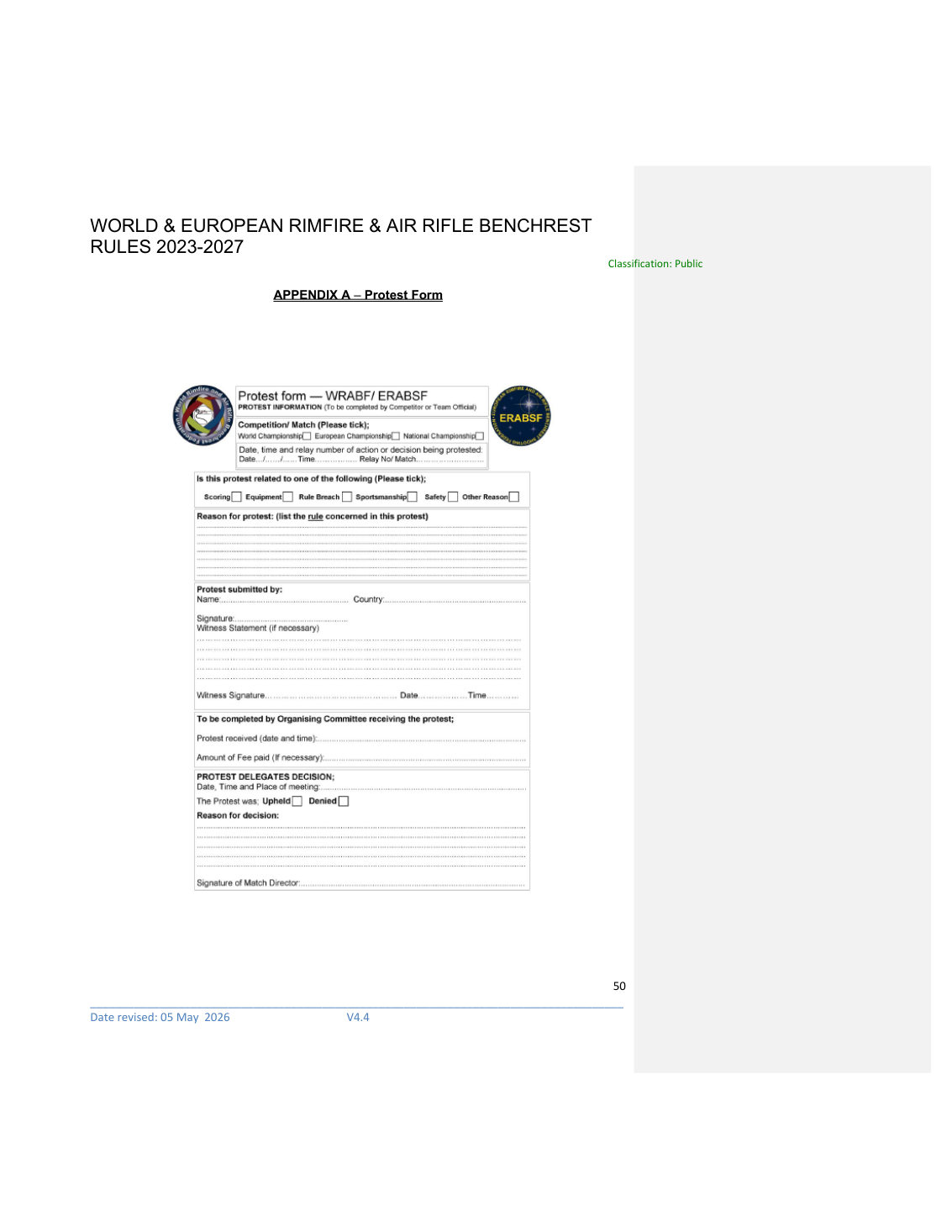
APPENDIX B – Hosting Form
Original appendix form from the English PDF — displayed as a page image so no form fields are lost.
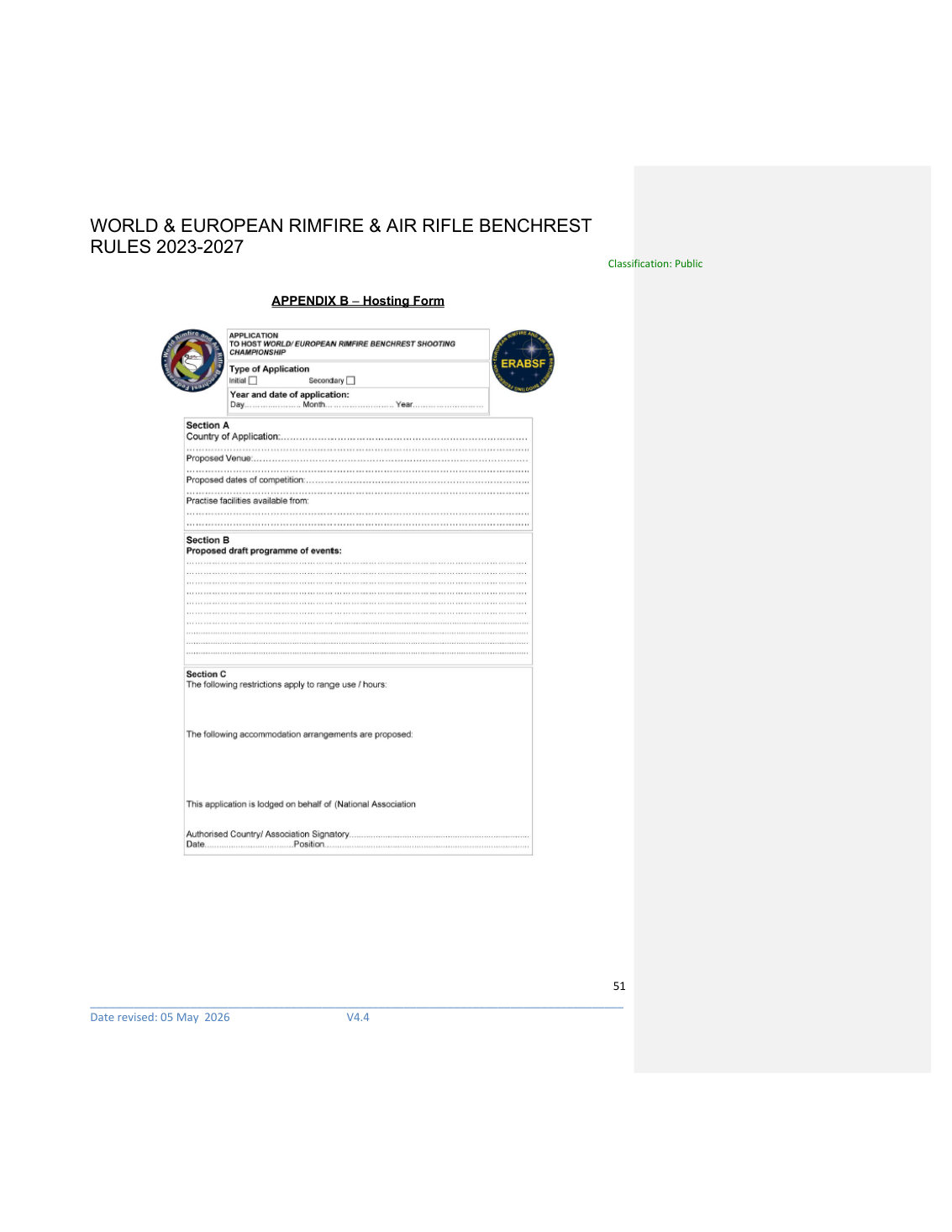
APPENDIX C – Record Application
Original appendix form from the English PDF — displayed as a page image so no form fields are lost.
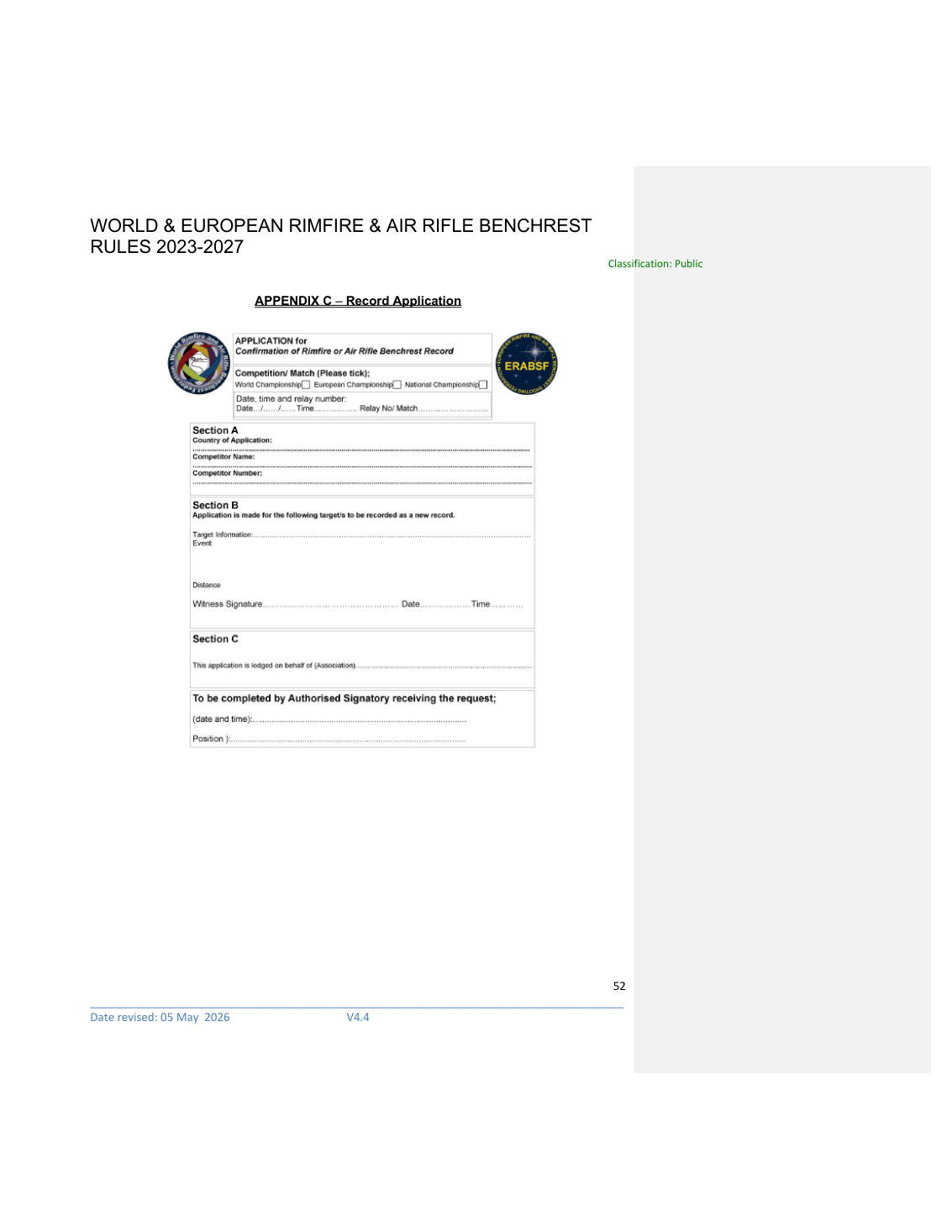
APPENDIX D – Rifle Inspection
Original appendix form from the English PDF — displayed as a page image so no form fields are lost.
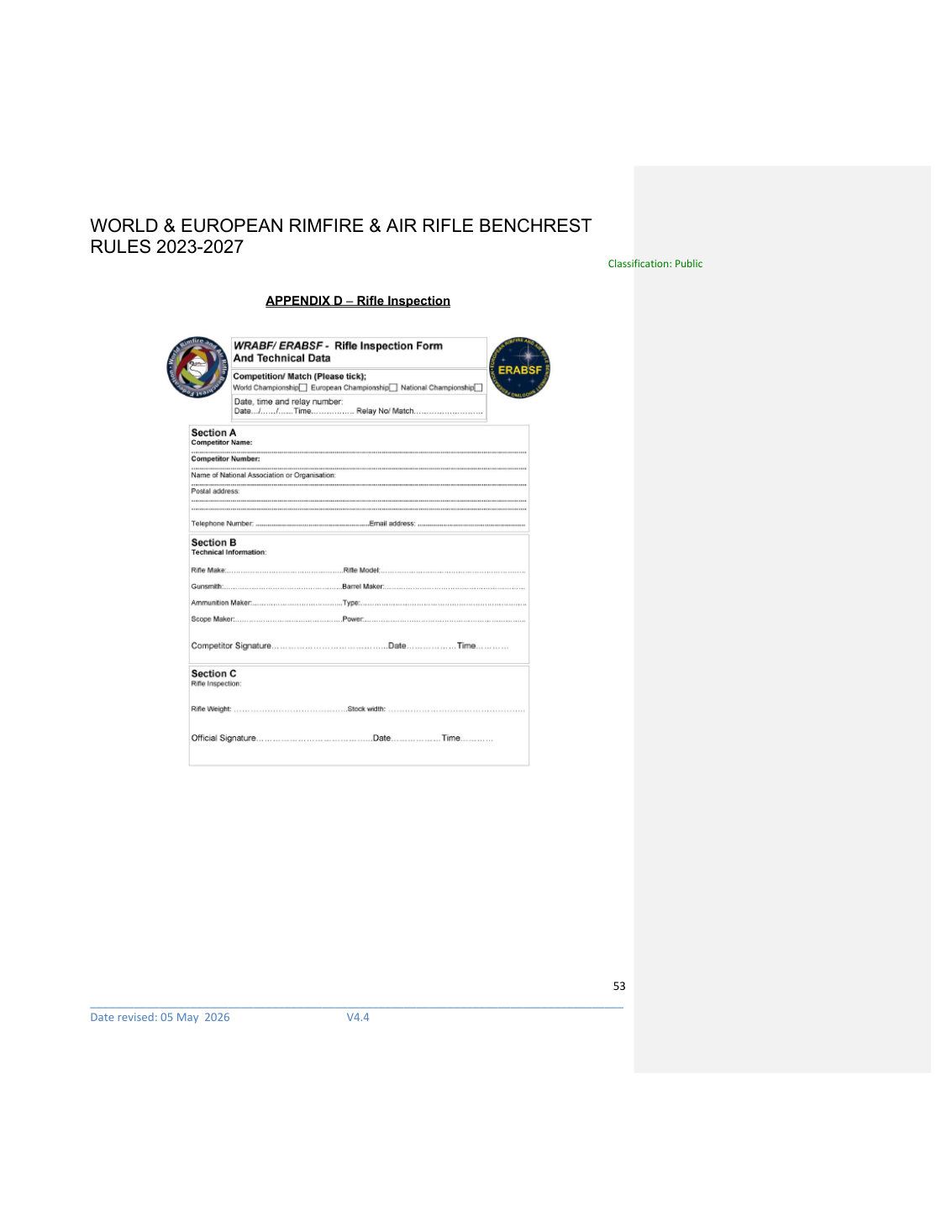
APPENDIX E –Targets
View original PDF tables / diagrams (pages 54, 55, 56, 57)
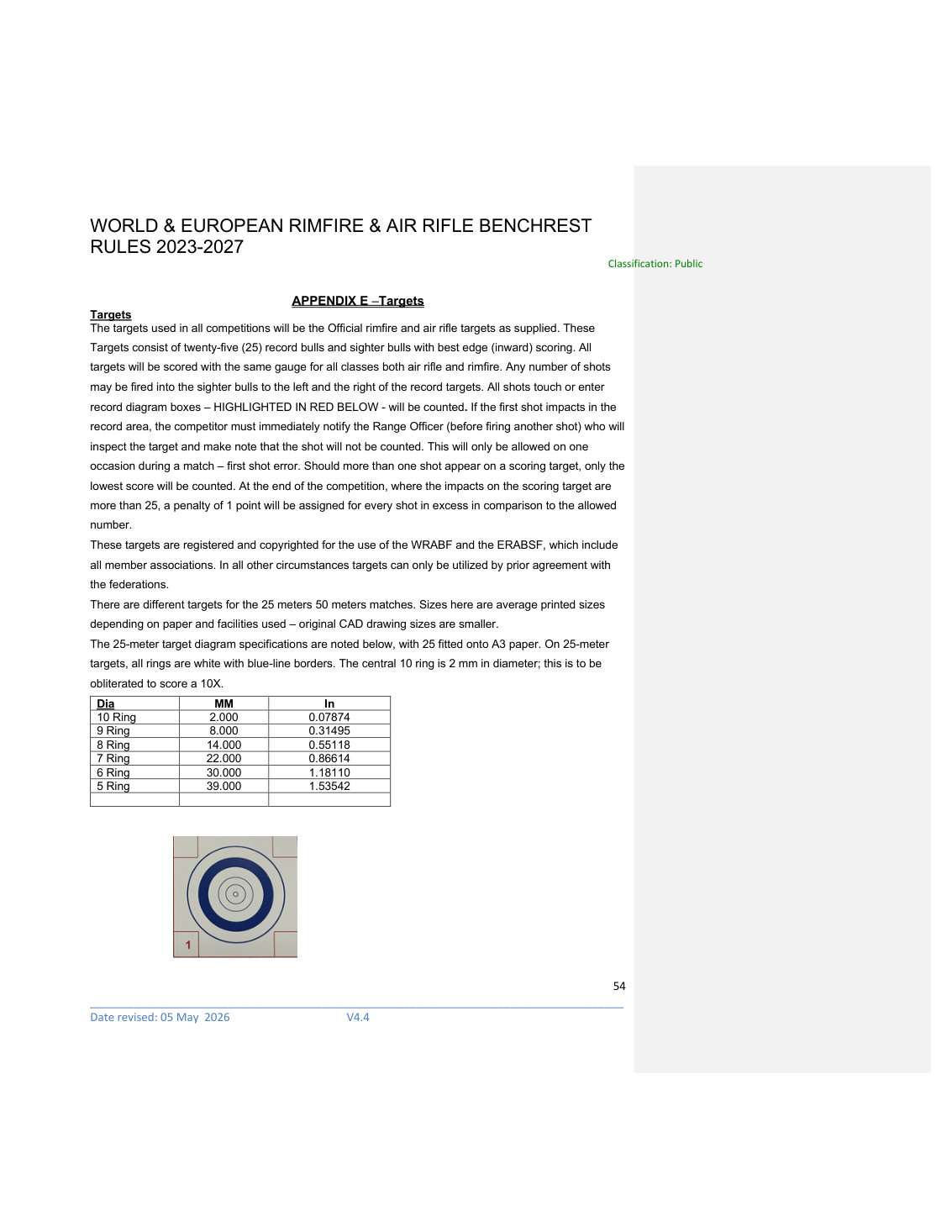
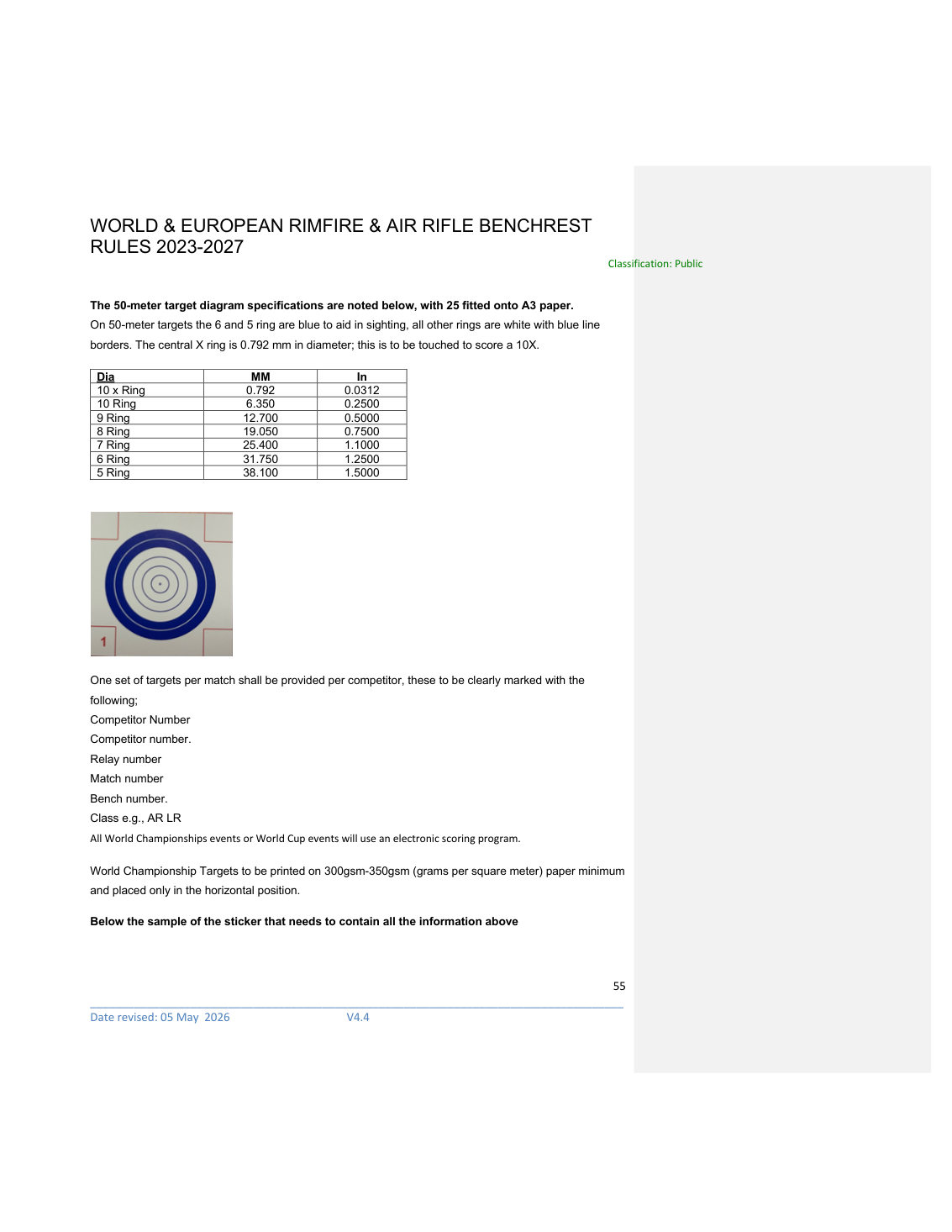
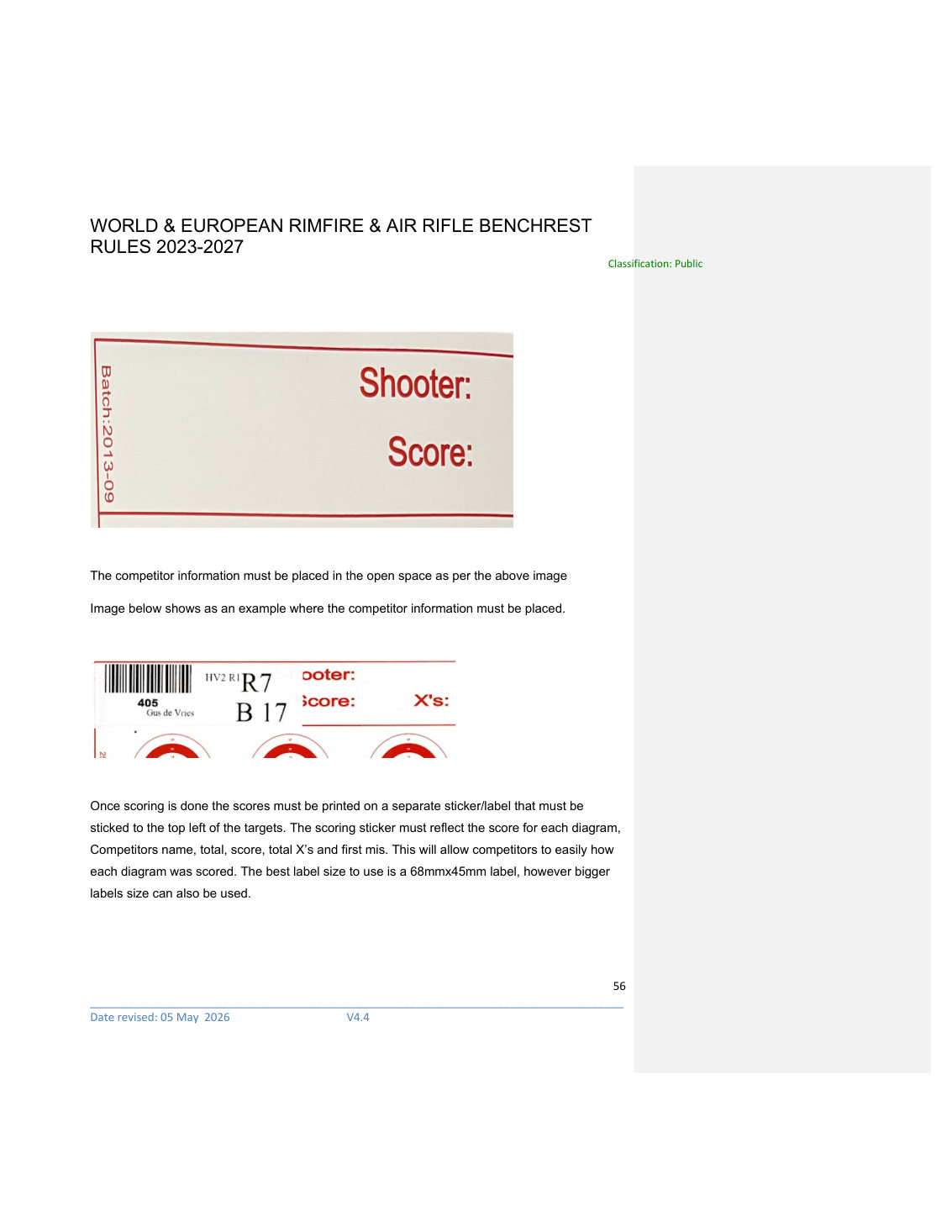
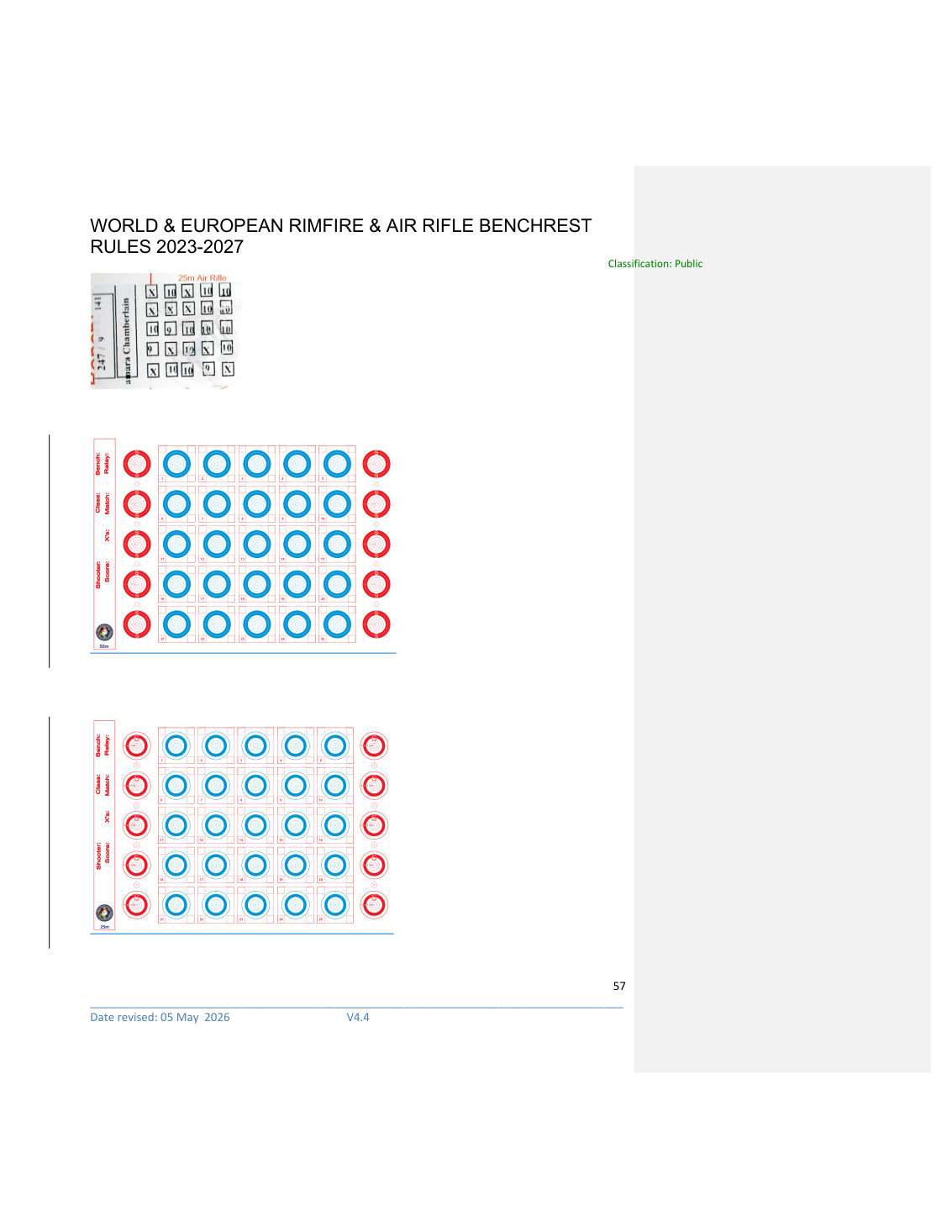
Targets The targets used in all competitions will be the Official rimfire and air rifle targets as supplied. These Targets consist of twenty-five (25) record bulls and sighter bulls with best edge (inward) scoring. All targets will be scored with the same gauge for all classes both air rifle and rimfire. Any number of shots may be fired into the sighter bulls to the left and the right of the record targets. All shots touch or enter record diagram boxes – HIGHLIGHTED IN RED BELOW - will be counted. If the first shot impacts in the record area, the competitor must immediately notify the Range Officer (before firing another shot) who will inspect the target and make note that the shot will not be counted. This will only be allowed on one occasion during a match – first shot error. Should more than one shot appear on a scoring target, only the lowest score will be counted. At the end of the competition, where the impacts on the scoring target are more than 25, a penalty of 1 point will be assigned for every shot in excess in comparison to the allowed number. These targets are registered and copyrighted for the use of the WRABF and the ERABSF, which include all member associations. In all other circumstances targets can only be utilized by prior agreement with the federations. There are different targets for the 25 meters 50 meters matches. Sizes here are average printed sizes depending on paper and facilities used – original CAD drawing sizes are smaller. The 25-meter target diagram specifications are noted below, with 25 fitted onto A3 paper. On 25-meter targets, all rings are white with blue-line borders. The central 10 ring is 2 mm in diameter; this is to be obliterated to score a 10X. Dia MM In 10 Ring 2.000 0.07874 9 Ring 8.000 0.31495 8 Ring 14.000 0.55118 7 Ring 22.000 0.86614 6 Ring 30.000 1.18110 5 Ring 39.000 1.53542 The 50-meter target diagram specifications are noted below, with 25 fitted onto A3 paper. On 50-meter targets the 6 and 5 ring are blue to aid in sighting, all other rings are white with blue line borders. The central X ring is 0.792 mm in diameter; this is to be touched to score a 10X.
One set of targets per match shall be provided per competitor, these to be clearly marked with the following; Competitor Number Competitor number. Relay number Match number Bench number. Class e.g., AR LR All World Championships events or World Cup events will use an electronic scoring program.
World Championship Targets to be printed on 300gsm-350gsm (grams per square meter) paper minimum and placed only in the horizontal position.
Below the sample of the sticker that needs to contain all the information above The competitor information must be placed in the open space as per the above image
Image below shows as an example where the competitor information must be placed.
Once scoring is done the scores must be printed on a separate sticker/label that must be sticked to the top left of the targets. The scoring sticker must reflect the score for each diagram, Competitors name, total, score, total X’s and first mis. This will allow competitors to easily how each diagram was scored. The best label size to use is a 68mmx45mm label, however bigger labels size can also be used.
APPENDIX F
View original PDF page (58)
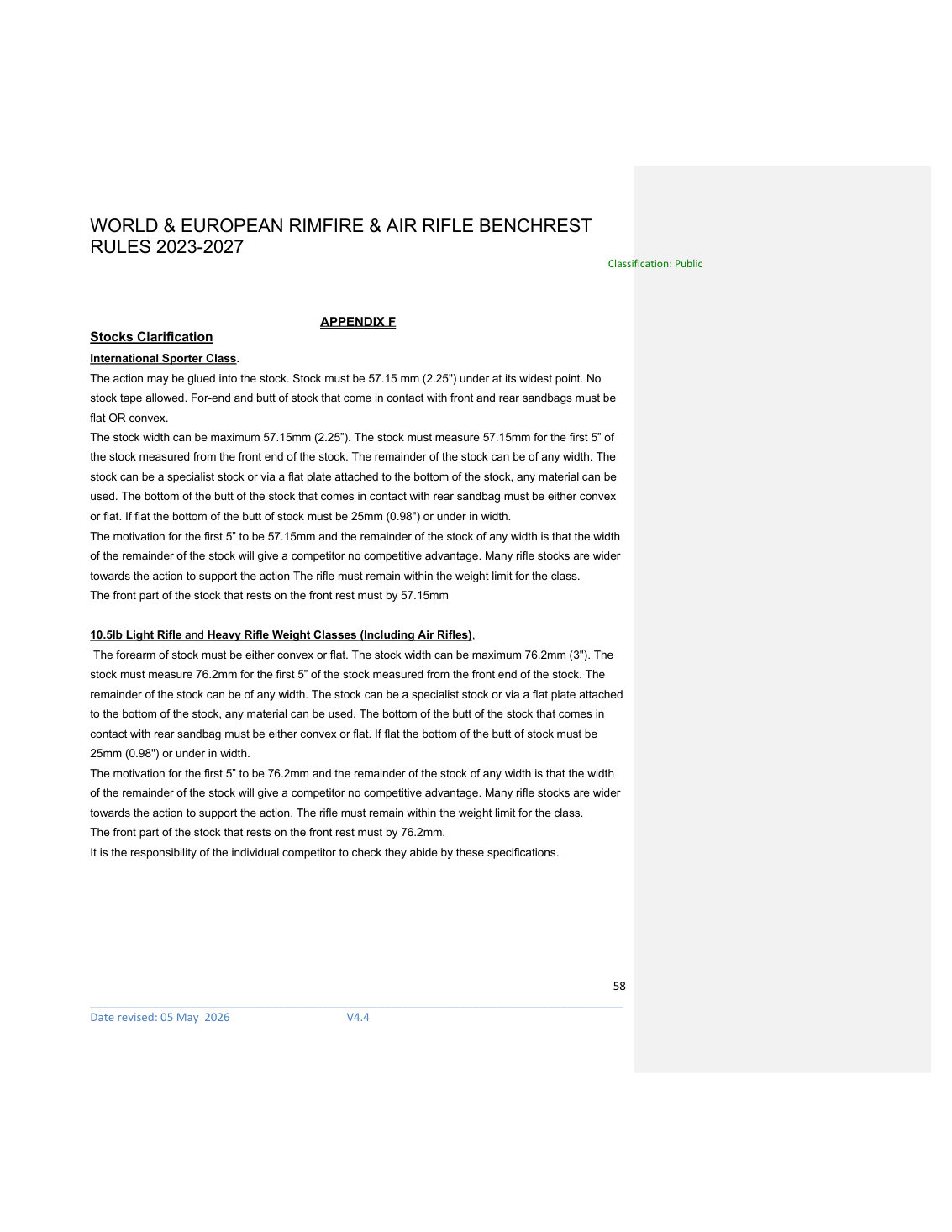
Stocks Clarification International Sporter Class. The action may be glued into the stock. Stock must be 57.15 mm (2.25") under at its widest point. No stock tape allowed. For-end and butt of stock that come in contact with front and rear sandbags must be flat OR convex. The stock width can be maximum 57.15mm (2.25”). The stock must measure 57.15mm for the first 5” of the stock measured from the front end of the stock. The remainder of the stock can be of any width. The stock can be a specialist stock or via a flat plate attached to the bottom of the stock, any material can be used. The bottom of the butt of the stock that comes in contact with rear sandbag must be either convex or flat. If flat the bottom of the butt of stock must be 25mm (0.98") or under in width. The motivation for the first 5” to be 57.15mm and the remainder of the stock of any width is that the width of the remainder of the stock will give a competitor no competitive advantage. Many rifle stocks are wider towards the action to support the action The rifle must remain within the weight limit for the class. The front part of the stock that rests on the front rest must by 57.15mm
10.5lb Light Rifle and Heavy Rifle Weight Classes (Including Air Rifles), The forearm of stock must be either convex or flat. The stock width can be maximum 76.2mm (3"). The stock must measure 76.2mm for the first 5” of the stock measured from the front end of the stock. The remainder of the stock can be of any width. The stock can be a specialist stock or via a flat plate attached to the bottom of the stock, any material can be used. The bottom of the butt of the stock that comes in contact with rear sandbag must be either convex or flat. If flat the bottom of the butt of stock must be 25mm (0.98") or under in width. The motivation for the first 5” to be 76.2mm and the remainder of the stock of any width is that the width of the remainder of the stock will give a competitor no competitive advantage. Many rifle stocks are wider towards the action to support the action. The rifle must remain within the weight limit for the class. The front part of the stock that rests on the front rest must by 76.2mm. It is the responsibility of the individual competitor to check they abide by these specifications.
Unlimited class stock clarification
The unlimited class has no stock rules. Stocks can be from any material and any shape and any width. Air Rifles competing in the unlimited class can shoot of a front rest, back rest, X-bag or bi-pods.
APPENDIX G
View original PDF tables / diagrams (pages 59)
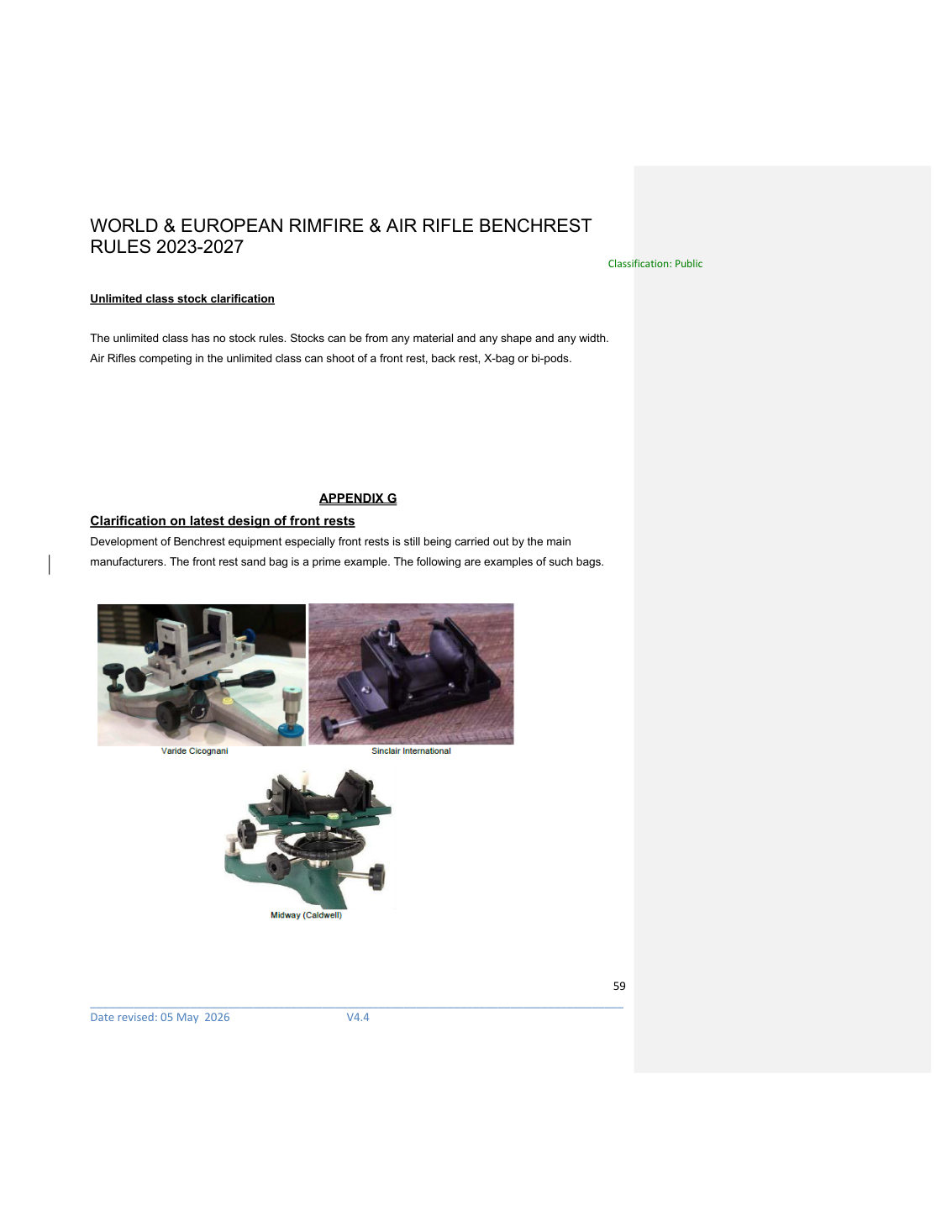
Clarification on latest design of front rests Development of Benchrest equipment especially front rests is still being carried out by the main manufacturers. The front rest sand bag is a prime example. The following are examples of such bags.
APPENDIX H
View original PDF pages (60, 61)
TECHNICAL MEETING AGENDA TECHNICAL MEETING - elements of this agenda may be placed on official notice boards as confirmation memo’s Technical Meeting: This to be held at the championship range at least 24 hours before the commencement of a competition/ match. The purpose of the meeting is to ensure staff and Team Officials are briefed on final arrangements for the Championship, and to deal with any particular concerns. The following are required to attend: All Delegation Leaders and Interpreters as required.
OFFICIAL WELCOME Item 1 Welcome to delegates Item 2 Introduction of senior operating personnel. Item 3 Introduction any new countries
CHAMPIONSHIP SECRETARY Item 1 Advice on Operations Office and hours attended. Item 2 Confirmation of official Information Board of Organising Committee for posting of notices, results etc. Item 3 Marketing souvenirs etc. Item 4 Photographer arrangements. Item 5 Opening and Closing Ceremonies (and Official / informal functions) Item 6 Medal Ceremonies and Medal Distribution Item 7 Official / informal functions, Item 8 Practise arrangements.
CHAMPIONSHIP MANAGER Item 1 Advice on Equipment Control arrangements and times. Item 2 Confirmation of programme of events Item 3 Confirmation on start times. Item 4 Confirmation of bench allocation and rotation. Item 5 Confirmation of target posting and result distribution. Item 6 Confirmation of protest procedures and fees. Item 7 Confirmation of Protest Committee Item 8 Reminder – Crossfire Procedures Item 9 Armory arrangements and/or range security. Item 10 Range parking. Item11 Other range information.
ANY OTHER BUSINESS QUESTION AND ANSWER SESSION! GENERAL ITEMS QUESTION AND ANSWER.
APPENDIX I
View original PDF page (62)
Delegates General Meeting Agenda – separate meetings for WRABF and ERABSF Welcome by Chairman/ President. Apologies Minutes of previous meeting Business arising from previous meeting. Chairman President report to Delegates. Presentation - New Country Memberships Confirmation – Country Delegates and Contact Information Discussion Papers Presentations Progress report next World/ European Championship Bids for Championship 4 years in advance Notification Bids 4 years in advance General Business
APPENDIX H - WRABF/ERABSF RECORDS
Source note: This final page is labelled APPENDIX H in the original PDF, even though APPENDIX H already appears earlier for the technical meeting agenda. The original numbering has been preserved.
View original PDF page (63)

Recorded on the WRABF website – http://www.wrabf.com/Hall%20of%20Fame.htm
Recorded on the ERABSF website - http://www.erabsf.org/ERABSFHall%20of%20Fame.htm